
 vs
vs
Sendbox vs Instantly 2026: One Unified Platform Against a Five-Product Portfolio
How Instantly's five-subscription product family (Outreach, Growth Leads, Verification, Inbox Placement, CRM) stacks up against Sendbox's single login that covers the same ground. We look at what this structural difference means day to day, how much vendor overhead it creates, and how outbound teams actually operate under each model.

At a glance
17 features Sendbox edge11
- Tie5
 Instantly edge1
Sendbox from
$99/mo
Instantly from
$47/mo
The verdict
Instantly and Sendbox solve for the same outcome from opposite directions. Instantly ships five separate products under one brand and one login, Outreach, Growth Leads, Verification, Inbox Placement, and CRM, each with its own team, its own roadmap, and its own upgrade cadence. Sendbox folds that same surface area into a single subscription.
That structural choice has two real consequences. First, on vendor overhead: a team running Instantly's full stack is tracking five subscriptions, five renewal dates, and five places where a feature could shift without warning, while a Sendbox team tracks one. Second, on depth: because each Instantly product team focuses on a single surface, they push specialty features further than a bundled tool typically can, the Growth Leads database ships 13 filters plus an AI email writer built into the data view, and Inbox Placement is a standalone tool built around its own deliverability methodology.
Sendbox's equivalent surfaces work well but don't chase that same specialization. So the decision comes down to which trade-off suits how your team operates: more specialized tooling in exchange for juggling multiple products, or one coherent surface in exchange for slightly less depth per feature. Anyone weighing the actual dollar cost of running Instantly's five-product stack should check the dedicated pricing breakdown.

Where it leads
Sendbox
- One subscription covers sequences, calls, CRM, finder, verifier, and inbox
- Single navigation surface lowers context-switching cost during daily work
- API-key import path from Instantly campaigns finishes in an afternoon

Where it leads
Instantly
- Specialty product teams iterate faster on their specialty surfaces
- Growth Leads has deeper filter set and AI email writer inside the data view
- Inbox Placement is a dedicated, deliverability-methodology-led product
Feature by feature
Sendbox vs Instantly: Feature-by-Feature
Filter by category, or show only the rows where the two tools actually differ.
| Feature | Sendbox | Instantly |
|---|---|---|
| Infrastructure | ||
| Dedicated IPs | Sendbox Every planEdge Every tier ships with a dedicated IP from the moment you sign up, no plan requires an upgrade to get one | Instantly Enterprise only Instantly offers this under the name Private Deliverability Network, but only as a custom-quoted Enterprise add-on |
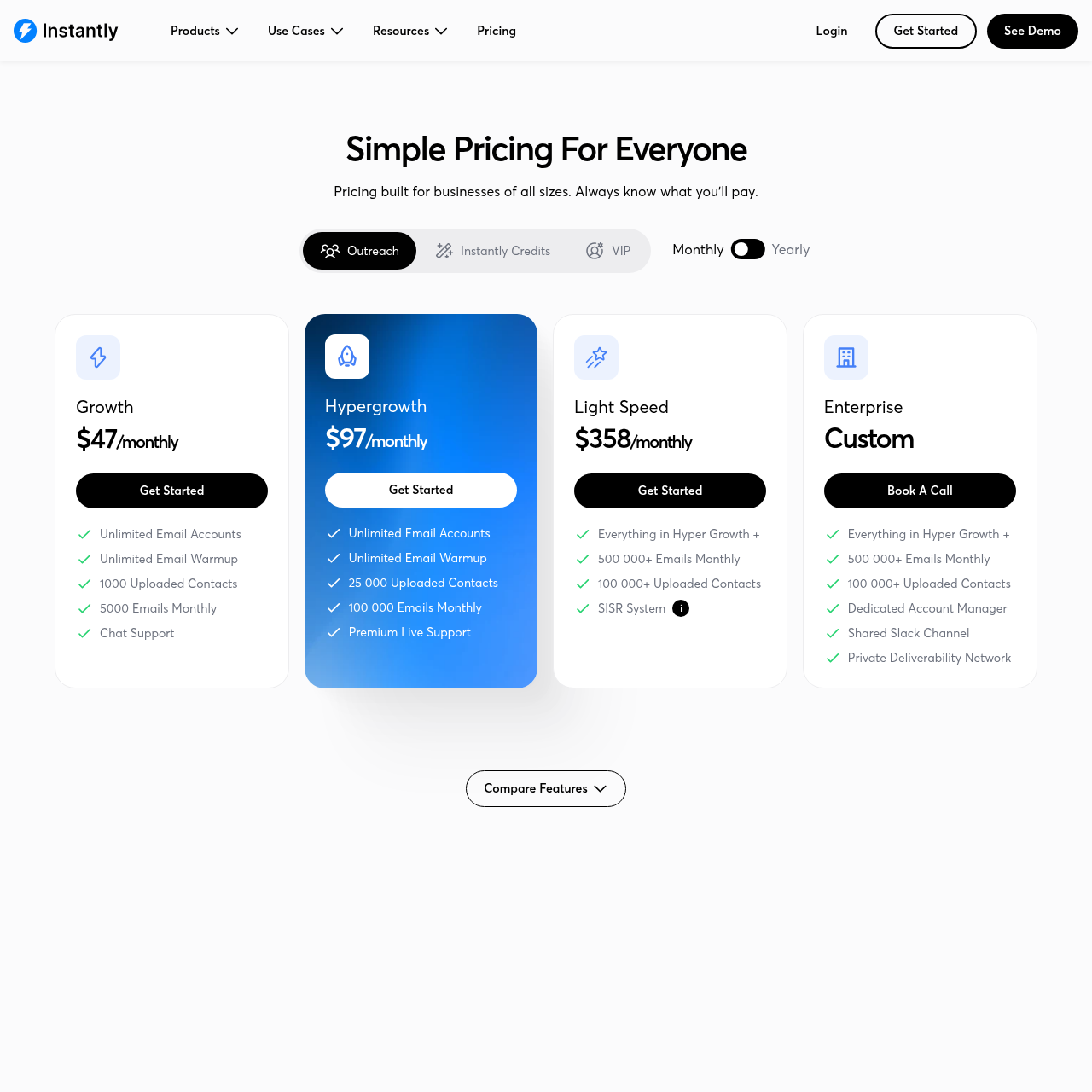
| Isolated Infrastructure | Sendbox YesEdge Sending infrastructure is fully siloed per customer, nothing is pooled or shared across accounts | Instantly No Growth ($47), Hypergrowth ($97), and Light Speed ($358) tiers all send through shared IP pools rather than dedicated infrastructure |
| Email Warmup | Sendbox Unlimited, AI-poweredEdge Warmup is AI-driven and tuned specifically to get past Gmail and Outlook's spam detection | Instantly Unlimited Every Outreach tier includes standard, non-AI warmup as part of the base subscription |
| Email Validation | Sendbox Built-in, every planEdge Deliverability checks run through 10+ provider integrations, with Enrich.so bundled in or the option to bring your own API key | Instantly Separate product Verification lives outside Outreach entirely, it's a separate product with its own bill |
| Inbox Placement Testing | Sendbox Built-inEdge Run a placement check before launch to see whether a campaign lands in the inbox or the spam folder | Instantly Separate product This is its own paid product at Instantly, not something folded into the Outreach subscription |
| Blacklist Monitoring | Sendbox Built-inEdge Get notified the moment any sending IP lands on a blacklist | Instantly No None of Instantly's tiers include built-in blacklist monitoring |
| Sending | ||
| Email Accounts | Sendbox Unlimited Capped only by a fair-use ceiling generous enough that ordinary usage never approaches it | Instantly Unlimited Every Outreach plan allows an unlimited number of connected mailboxes |
| Monthly Emails | Sendbox 75K to 2.5MEdge Ranges from 75K on the entry tier up to 2.5M on the top tier | Instantly 5K to 500K+ Starts at 5K on the $47 Growth plan and scales to 500K+ on the $358 Light Speed plan |
| Lead Storage | Sendbox 30K to UnlimitedEdge 30K of storage on the entry tier, climbing to unlimited on the higher tiers | Instantly 1K to 100K+ 1,000 on the $47 Growth tier, 25,000 on the $97 Hypergrowth tier, and 100K+ on the $358 Light Speed tier |
| Features | ||
| Multi-Step Sequences | Sendbox Yes Sequences support conditional branching logic alongside A/B variant testing | Instantly Yes All Outreach tiers include multi-step sequences with A/B testing built in |
| AI Reply Agent | Sendbox Yes Replies across every connected inbox get auto-categorized and drafted automatically | Instantly Yes Handled through the AI Sales Agent and AI Copilot, which sit outside the core Outreach product |
| Unified Inbox | Sendbox Yes One inbox view aggregates every connected account | Instantly Yes Shipped as the Unibox feature inside the Outreach product |
| Built-in Dialer | Sendbox YesEdge Cold calling is built into the platform natively and included at every tier | Instantly No None of Instantly's products include a native calling feature |
| CRM | Sendbox Yes A pipeline CRM with deal tracking ships as part of the core product | Instantly Yes CRM is its own product at Instantly and isn't bundled into any Outreach plan |
| Lead Database | Sendbox Built-in finder A lead finder is built directly into the platform | Instantly 450M+ contactsEdge Growth Leads is a separate purchase, starting at $47/mo for 1,500 to 2,000 credits |
| Webhooks | Sendbox YesEdge Six event types are supported, each with HMAC signature verification | Instantly Basic Webhook support is standard, covering the usual integration events |
| Scale | ||
| White-label | Sendbox Pro tier and aboveEdge Full white-labeling with custom-branded reporting available on the Pro tier and above | Instantly Enterprise only Only available on Enterprise, priced through a custom quote with no published rate |
Showing 17 of 17 features.
Switch to Sendbox
Dedicated IPs. Isolated infrastructure. From $99/mo.
Pricing
Pricing Comparison
SendboxAll-in-one- $99/mo
Essential
Emails 75,000Leads 30,000
Single subscription
- $249/mo
Plus
Emails 250,000Leads 100,000
Single subscription
- $499/mo
Pro
Emails 500,000Leads Unlimited
Single subscription, white-label
- $899/mo
Agency
Emails 2,500,000Leads Unlimited
Single subscription, account manager
Instantly- $47/mo
Outreach Growth
Emails 5,000Leads 1,000
Outreach product only
- $97/mo
Outreach Hypergrowth
Emails 100,000Leads 25,000
Outreach product only
- $358/mo
Outreach Light Speed
Emails 500,000+Leads 100,000+
Outreach product only
- $47/mo
Growth Leads (add-on)
Emails Separate billingLeads 1,500-2,000 credits
Database, separate subscription
- Each separate
Verification, Placement, CRM (add-ons)
Emails Separate billingLeads Each separate
Each is a distinct purchase
Pricing takeaway
Instantly's pricing requires reading across multiple product lines to assemble a real-world bill. Sendbox's pricing is one ladder. The product-stacking dynamics matter more than the sticker prices; the full breakdown including how credits inside Growth Leads burn and what real Enterprise quotes look like is at /instantly-pricing.
Five products under one brand vs one product under one brand
Instantly's strategic bet is that buyers want specialized tools that share a brand. The five product lines (Outreach, Growth Leads, Verification, Inbox Placement, CRM) each get their own product team, their own roadmap, and their own deeper feature surface than a bundled tool can sustain. The Growth Leads database has 13 search filters and an AI email writer built into the data view; the Inbox Placement product has a dedicated deliverability methodology; the Outreach sequencer is paid attention as its own thing rather than as a feature inside something else.
Sendbox's bet is the opposite: buyers want one tool that does the job end-to-end, even if each surface is slightly leaner than the specialized competitor. The sequencer, the finder, the verifier, and the inbox are part of the same product surface and share the same data model, the same auth, and the same renewal cycle. The right choice depends on your operating preference.
Teams that already manage a complex SaaS stack find adding five Instantly products manageable. Teams that have consolidated tools or are starting fresh prefer the Sendbox single-surface model. Neither approach is universally correct.
Key takeaways
- Instantly bets on specialization across five product lines
- Sendbox bets on consolidation in one product line
- Specialty depth vs unified surface is the real trade-off
- Operating preference, not feature checklist, decides the right fit
What the daily UX actually feels like on each platform
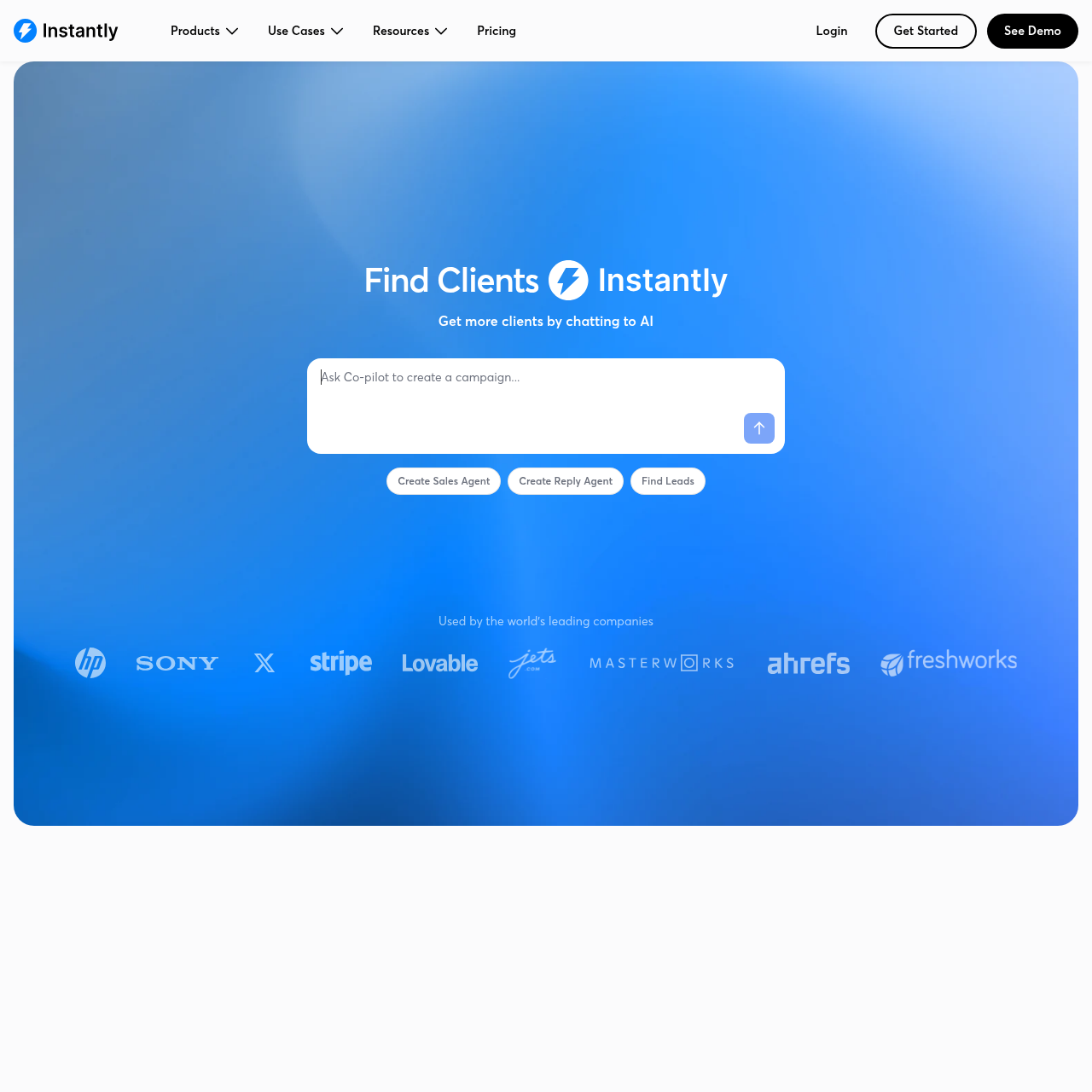
Open Instantly Outreach on a Monday morning. Campaign dashboard, mailbox health, unibox. To check the database for new prospects, you click into Growth Leads, which loads a different product UI with its own navigation.
To run verification on a list before send, you switch into the Verification product. To test inbox placement, you switch into the Inbox Placement product. Each product is competent; the context switching is the daily cost.
Open Sendbox on a Monday morning. Campaign dashboard, mailbox health, unified inbox, finder, verifier, dialer, and CRM are all in one navigation rail. To check the database for new prospects, you stay in the same product and click "Finder" in the sidebar.
To verify a list before send, the verifier runs inline on the campaign step. The trade-off is that each surface is slightly less specialized than the corresponding Instantly product team would build it. For teams running outbound as a full-time function, the Instantly context-switching is usually fine because the deeper specialty features in each product justify the navigation cost.
For teams running outbound as one of several functions (founders, part-time SDRs, RevOps generalists), the Sendbox single-surface model is materially less friction.
Key takeaways
- Instantly: jump between product UIs for finder, verifier, placement
- Sendbox: same UI for all of those, slightly leaner specialty depth
- Specialty depth justifies friction for full-time outbound teams
- Single surface justifies leaner depth for part-time outbound teams
Start sending today
Set up in 15 minutes. Dedicated IPs on every plan.
Vendor management overhead with multi-product stacks
A team running the full Instantly stack manages five subscriptions, five renewals, five product roadmaps, and five places where features can land or get reshuffled. None of this is hard, but it adds up at scale. RevOps teams supporting Instantly-stack accounts often build a tracker just to know which product is renewing when.
A team running Sendbox manages one subscription. The renewal date is one date. New features ship into the same product.
The vendor management overhead is genuinely lower, and at scale (mid-market teams, agencies running multiple clients) the difference compounds. The inverse trade-off: if Instantly ships a major upgrade to Growth Leads (say, expanded filters or a better AI writer), the upgrade is immediate inside that product. The equivalent Sendbox upgrade has to fit inside the overall product roadmap and may take longer to surface.
Specialty teams iterate faster on their specialty.
Key takeaways
- Five subscriptions across five renewal dates on the full Instantly stack
- One subscription on Sendbox
- Mid-market and agency teams feel the management overhead more
- Specialty product teams iterate faster on their specialty
Migrating between the two ecosystems
Instantly to Sendbox: the path is one of the smoother migrations in the category because Sendbox publishes an API-key import for Instantly campaigns, leads, and mailboxes. The actual workflow: paste your Instantly API key into Sendbox's migration screen, pick which campaigns to import, confirm the mailbox connections, and run. Most single-product migrations finish in an afternoon.
Multi-product migrations (Outreach + Growth Leads + Verification) take longer because you have to export each product line separately. Sendbox to Instantly: the path is more manual because Sendbox's consolidated surface needs to be split across Instantly's products on the receiving side. The sequencer maps to Outreach.
The finder data maps to Growth Leads. The verifier maps to Verification. Each receiving product has its own import flow.
Plan a full day for the cross-product split rather than an afternoon for a single-product move.
Key takeaways
- Instantly to Sendbox: API-key import, afternoon for a single product
- Multi-product migrations take a full day because each product exports separately
- Sendbox to Instantly: manual cross-product splitting on the receiving side
- The split direction takes longer than the consolidate direction
Strengths & limitations
Pros & Cons
Strengths5
- One subscription covers sequences, calls, CRM, finder, verifier, and inbox
- Single navigation surface lowers context-switching cost during daily work
- API-key import path from Instantly campaigns finishes in an afternoon
- Lower vendor management overhead (one renewal, one roadmap, one support channel)
- Native dialer surface for post-reply call workflow
Limitations4
- Specialty feature depth is lower than Instantly's dedicated product teams achieve
- No equivalent of Instantly's standalone Inbox Placement product depth
- Database surface is functional but does not match Growth Leads filter count
- Single-product roadmap means specialty improvements move slower
Strengths5
- Specialty product teams iterate faster on their specialty surfaces
- Growth Leads has deeper filter set and AI email writer inside the data view
- Inbox Placement is a dedicated, deliverability-methodology-led product
- Established brand with a large community and content library
- Best fit for full-time outbound teams who already manage complex SaaS stacks
Limitations5
- Five subscriptions to manage at the full stack (Outreach, Leads, Verification, Placement, CRM)
- Five renewal dates, five roadmaps, five support channels
- Context-switching between product UIs during daily work
- No native dialer or call workflow in any Instantly product
- Migration to or from is more complex because surfaces are split
Source material
Instantly Screenshots
Ready to switch?
Your reputation, your control. No shared infrastructure.
Keep reading
Full-time outbound teams that already manage complex SaaS stacks usually find the Instantly multi-product model workable because the specialty depth in each product justifies the context-switching. Founders, part-time SDRs, and RevOps generalists usually prefer the Sendbox single-surface model because the friction of managing five subscriptions outweighs the depth gained.
Ready to land in primary?
Get your own isolated Sendbox setup running and start sending inside 15 minutes.
Every plan includes a dedicated IP. Cancel whenever you want.