
 vs
vs
Sendbox vs Apollo 2026: One Shared Credit Pool vs Three Separate Buckets
Apollo's Basic tier hands you a single 30K-credit pool each year that every data job draws down from. Sendbox keeps email volume, finder usage, and verification as three distinct allowances instead of one shared pot.

At a glance
17 features Sendbox edge9
- Tie3
 Apollo.io edge5
Sendbox from
$99/mo
Apollo.io from
$0/mo
The verdict
Apollo.io stands out as one of the more complete sales platforms out there, a database north of 275M contacts, a free tier that includes 900 credits, waterfall enrichment, and per-user pricing that opens at $49/user/mo all make it an appealing all-in-one option. The trade-offs are that it runs on shared infrastructure, bills per user, and the credit system puts a ceiling on how much data any given tier can actually pull. Sendbox takes a different entry point: dedicated IPs, infrastructure isolated per customer, unlimited connected mailboxes, and no per-user charges at all.
Teams that put deliverability first and want predictable monthly costs will generally get more out of Sendbox's infrastructure. Teams that need a sprawling lead database, a built-in CRM, and sales intelligence bundled into one product will find Apollo covers ground Sendbox doesn't.

Where it leads
Sendbox
- Dedicated IPs on every plan from $99/mo, fully isolated infrastructure
- No per-user pricing, entire team on one flat plan regardless of size
- All deliverability tools included: warmup, validation, placement testing, blacklist monitoring

Where it leads
Apollo.io
- 275M+ contact database with advanced filters and waterfall enrichment
- Free tier with 900 credits/year and 2 sequences for initial testing
- Full CRM included on Basic plan and above
Feature by feature
Sendbox vs Apollo.io: Feature-by-Feature
Filter by category, or show only the rows where the two tools actually differ.
| Feature | Sendbox | Apollo.io |
|---|---|---|
| Infrastructure | ||
| Dedicated IPs | Sendbox Every planEdge A dedicated IP is part of every tier from the start, at no extra cost | Apollo.io No Every plan tier shares its infrastructure |
| Isolated Infrastructure | Sendbox YesEdge Sending is fully siloed per account, with no shared pooling | Apollo.io No Sending infrastructure is shared across customers |
| Email Warmup | Sendbox Unlimited, AI-powered AI-driven warmup is built to slip past ESP detection systems | Apollo.io Included (Basic+) Warmup is bundled in starting with the Basic plan |
| Deliverability Suite | Sendbox Full suiteEdge Covers warmup, validation, placement testing, blacklist monitoring, and per-mailbox health visibility in one bundle | Apollo.io Basic+ The deliverability suite is included starting on the $49/user/mo Basic plan |
| Blacklist Monitoring | Sendbox Built-inEdge You get a real-time alert the instant a sending IP is blacklisted | Apollo.io No There's no native way to monitor for blacklisting |
| Sending | ||
| Email Accounts | Sendbox UnlimitedEdge Bounded only by a generous fair-use policy that typical usage never approaches | Apollo.io Per user The number of email accounts you can connect is tied directly to seat count |
| Sequences | Sendbox Unlimited Every plan tier allows unlimited sequences | Apollo.io 2 (Free) / Unlimited (Paid) The free tier caps you at 2 sequences; paid plans remove that cap entirely |
| Features | ||
| Lead Database | Sendbox Built-in finder A finder is built directly into the platform for sourcing leads | Apollo.io 275M+ contactsEdge Draws from a database of 275M+ contacts with advanced filtering and waterfall enrichment |
| Credits System | Sendbox 500-2K per plan Credit allotments scale with plan, from a few hundred up to a couple thousand per month | Apollo.io 900-72K/yearEdge Annual credits range from 900 on the free tier up to 72,000 on the Organization tier |
| Built-in Dialer | Sendbox YesEdge A native dialer with ringless voicemail, AI voice cloning, and line intelligence is included on every plan | Apollo.io Professional+ US dialing requires the $79/user/mo Professional plan, with international dialing as a further add-on |
| CRM | Sendbox Built-in CRM A pipeline CRM with deal tracking is part of the core product | Apollo.io Full CRM A complete built-in CRM is included starting on the Basic plan |
| A/B Testing | Sendbox Yes Sequences support A/B variant testing | Apollo.io A/Z Testing (Professional+)Edge A more advanced A/Z testing mode is reserved for the Professional plan and up |
| Call Recording | Sendbox No Calls aren't recorded natively | Apollo.io Professional+Edge Call recording is available starting on the $79/user/mo Professional plan |
| Webhooks | Sendbox YesEdge Six event types are covered, each with HMAC signature verification | Apollo.io API access A REST API is available on the paid plans |
| Scale | ||
| White-label | Sendbox Pro tier and aboveEdge Full white-labeling with custom-branded reports on the higher tiers | Apollo.io No No white-label option exists here |
| Pricing | ||
| Per-user Pricing | Sendbox NoEdge The whole team runs on one flat plan regardless of seat count | Apollo.io $49-$119/user/mo Every additional teammate adds its own line item to the bill |
| Free Tier | Sendbox No There's no free tier, every plan is a paid subscription | Apollo.io 900 credits/yearEdge A free plan is available with 900 annual credits, 2 sequences, and core features |
Showing 17 of 17 features.
Switch to Sendbox
Dedicated IPs. Isolated infrastructure. From $99/mo.
Pricing
Pricing Comparison
SendboxAll-in-one- $99/mo
Essential
Emails 75,000Leads 30,000
Dedicated IPs, validation, warmup, dialer included
- $249/mo
Plus
Emails 250,000Leads 100,000
All deliverability tools + 1,000 finder credits
- $499/mo
Pro
Emails 500,000Leads Unlimited
White-label, unlimited leads, full automation suite
- $899/mo
Agency
Emails 2,500,000Leads Unlimited
White-label, custom reports, dedicated support
Apollo.io- $0/mo
Free
Emails LimitedLeads 900 credits/year
2 sequences, basic filters, limited features
- $49/user/mo
Basic
Emails Unlimited sequencesLeads 30,000 credits/year
CRM, deliverability suite, warmup, advanced filters
- $79/user/mo
Professional
Emails Unlimited sequencesLeads 48,000 credits/year
A/Z testing, US dialer, automated workflows, call recordings
- $119/user/mo (min 3)
Organization
Emails Unlimited sequencesLeads 72,000 credits/year
SSO, customizable reports, min 3 users ($357/mo minimum)
Pricing takeaway
Apollo's per-user pricing adds up fast for teams. A team of 3 on Apollo Basic costs $147/mo. On Professional, that becomes $237/mo. Organization requires a minimum of 3 users at $357/mo. A team of 5 on Professional costs $395/mo. Sendbox Essential at $99/mo covers all 5 users with dedicated IPs, 75K emails, and no per-user fees. Sendbox Plus at $249/mo gives that team 250K emails and 100K leads. Apollo's free tier is a genuine advantage for individuals testing the platform, and the 275M+ database is unmatched. But for team-based outbound at scale, Sendbox's flat pricing model is significantly more predictable.
Apollo Shared Sending vs Sendbox Isolated IPs
Apollo.io is primarily a sales intelligence and CRM platform that added outbound sequencing. The outreach features are capable, but the infrastructure is designed for a broad sales platform rather than a dedicated cold email tool. Sendbox assigns dedicated IPs to every account on every plan from $99/mo.
Your sending reputation is fully isolated. Apollo runs on shared infrastructure across all tiers, from Free through Organization. There is no dedicated IP option advertised on any Apollo plan.
Apollo does include a deliverability suite on Basic ($49/user/mo) and above, which covers warmup and email health features. This is a solid addition. But it operates on top of shared infrastructure, which means your deliverability still depends partly on other Apollo users on your IP cluster.
Sendbox bundles inbox placement testing, blacklist monitoring, per-mailbox health visibility, and email validation into every plan. Based on our review of Apollo's feature pages, they offer warmup and deliverability monitoring but we could not find equivalent inbox placement testing or blacklist monitoring as dedicated features. Sendbox also surfaces per-mailbox reply rate and bounce rate in real time, so you can pull struggling mailboxes into warmup before reputation damage compounds.
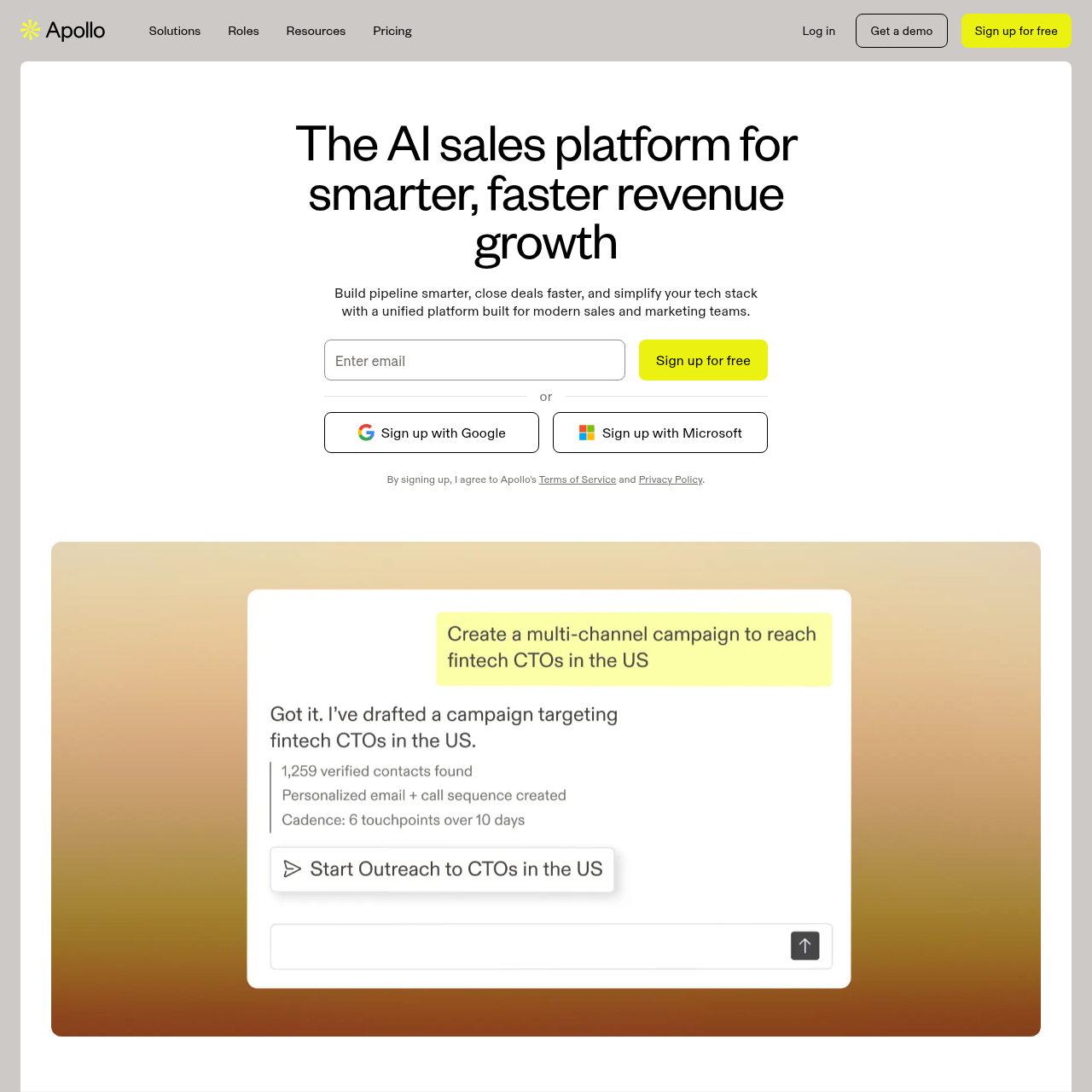
Apollo's strength is not infrastructure. It is the 275M+ contact database, waterfall enrichment, advanced filters, and the sales intelligence layer. If you already have strong deliverability practices and your primary need is prospect data, Apollo delivers enormous value.
If you need the infrastructure itself to protect your sender reputation, Sendbox is purpose-built for that.
Key takeaways
- Sendbox: Dedicated IPs on every plan, fully isolated infrastructure from $99/mo
- Apollo: Shared infrastructure on all plans, no dedicated IP option
- Apollo: Deliverability suite with warmup on Basic ($49/user/mo) and above
- Sendbox: Inbox placement testing, blacklist monitoring, and per-mailbox health visibility included
Lead Database and Sales Intelligence
This is where Apollo genuinely excels, and it deserves credit. Apollo's 275M+ contact database with advanced filters, waterfall enrichment, and intent signals is one of the most comprehensive prospecting tools available. The ability to search by job title, company size, industry, technology stack, and dozens of other filters makes it a powerful platform for building targeted prospect lists.
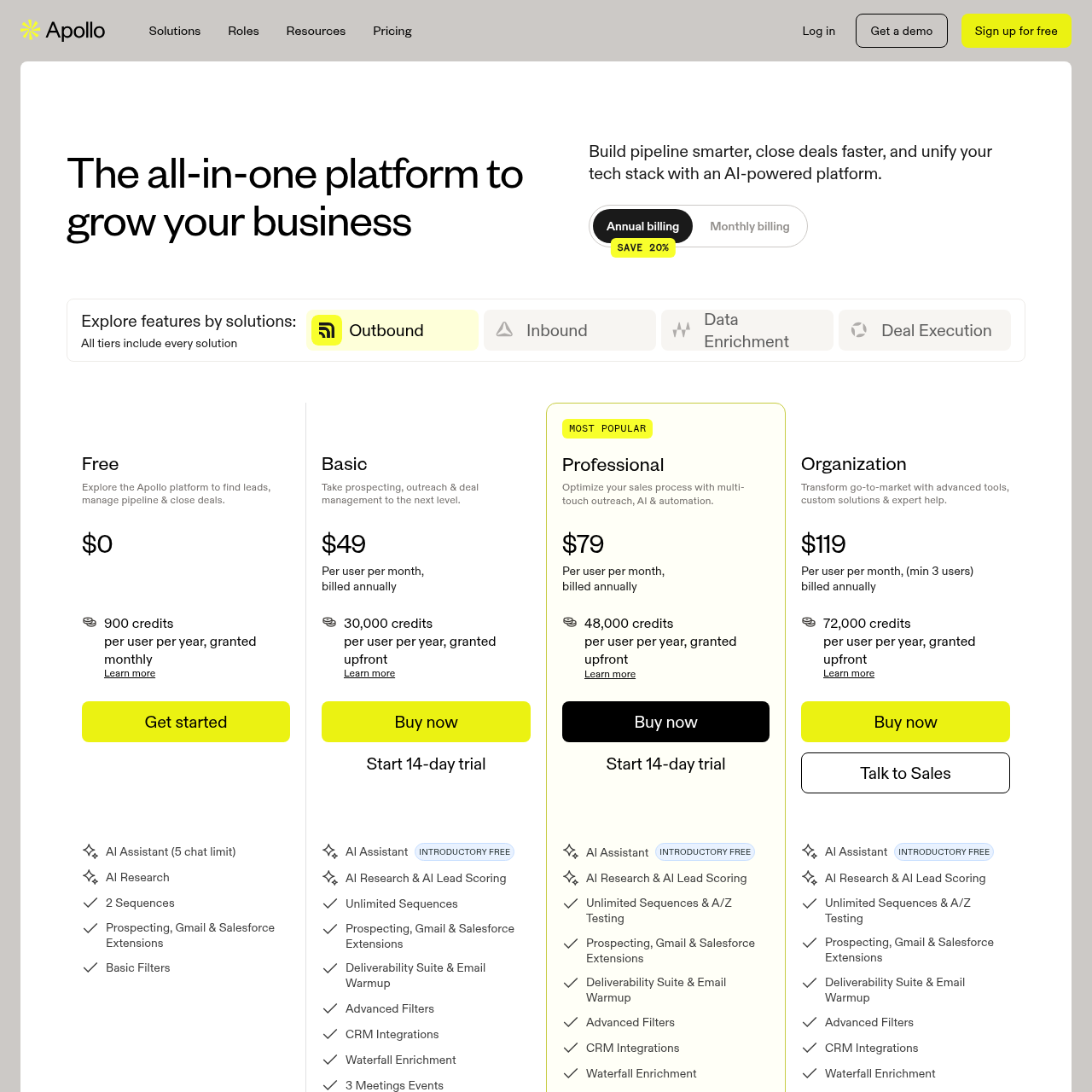
The credit system determines how much data you can access. The Free plan gives you 900 credits per year. Basic provides 30,000 credits per year.
Professional provides 48,000. Organization provides 72,000. Each email lookup or enrichment costs credits, so teams doing heavy prospecting can burn through their allocation quickly.
Additional credits cost extra. Apollo also offers website visitor identification as an add-on, which shows you which companies visit your site. This intent data layer adds context to outbound targeting that most cold email tools cannot provide.
Sendbox has a built-in lead finder with a 350M+ contact database. Sendbox allocates 500 finder credits on Essential, 1,000 on Plus, and 2,000 on Pro. Apollo's advantage is not just database size but the sales intelligence layer: intent signals, waterfall enrichment, and company alerts that Sendbox does not offer.
For teams that depend on intent-driven prospecting, Apollo is the stronger choice. For teams that need solid prospecting with dedicated sending infrastructure, Sendbox covers both.
Key takeaways
- Apollo: 275M+ contacts with advanced filters, waterfall enrichment, and intent signals
- Apollo credits: 900/year (Free), 30K/year (Basic), 48K/year (Professional), 72K/year (Organization)
- Apollo: Website visitor identification available as add-on
- Sendbox: Built-in finder with 350M+ contacts, 500 to 2,000 credits per plan
Start sending today
Set up in 15 minutes. Dedicated IPs on every plan.
Apollo Per-Seat Credits vs Sendbox Account Buckets
Apollo's per-user pricing creates a cost curve that scales with team size. We calculated the numbers for common team sizes to make this concrete. A solo user on Apollo Basic pays $49/mo.
That is cheaper than Sendbox Essential at $99/mo. For individuals, Apollo's pricing wins, especially with the free tier available for initial testing. But the math shifts as your team grows.
A team of 3 on Apollo Basic: $147/mo. On Professional: $237/mo. On Organization: $357/mo (minimum 3 users required).
A team of 5 on Professional: $395/mo. A team of 5 on Organization: $595/mo. A team of 10 on Professional: $790/mo.
Sendbox Essential at $99/mo covers the entire team regardless of size. Sendbox Plus at $249/mo gives that same team 250,000 emails and 100,000 leads. No per-user charges.
No minimum user requirements. For a team of 5, Sendbox Plus at $249/mo is 37% cheaper than Apollo Professional at $395/mo, and Sendbox includes dedicated IPs while Apollo runs shared infrastructure. For a team of 10, the gap widens further: $249/mo vs $790/mo.
The flip side: Apollo's per-user pricing includes access to their 275M+ database with credits at each tier. If your team relies heavily on Apollo's prospecting data, the per-user cost includes access to sales intelligence features (intent signals, waterfall enrichment) that Sendbox does not offer. The question is whether that data access justifies the per-user premium.
Key takeaways
- Apollo solo user: $49/mo (Basic), genuinely cheaper than Sendbox for individuals
- Apollo team of 5 (Professional): $395/mo; Sendbox Plus: $249/mo for the same team
- Apollo team of 10 (Professional): $790/mo; Sendbox Plus: $249/mo (no per-user fees)
- Apollo per-user pricing includes database access; evaluate if that data justifies the premium
Features and Workflow
Apollo is built as a full sales platform. Beyond sequences and email, it includes a CRM, automated workflows, call recordings (Professional and above), A/Z testing, customizable reports, and SSO on the Organization tier. The platform covers the entire sales workflow from prospecting to closing.
Sendbox is built as a cold email and outbound platform with deliverability at the center. The feature set is focused: sequences with conditional logic, A/B testing, a built-in dialer, CRM, unified inbox, lead finder, AI reply tagging, and comprehensive deliverability tooling. What Sendbox does not have is the sales intelligence layer that Apollo offers.
Apollo's A/Z testing on Professional plans is worth highlighting. While most platforms offer A/B testing with 2 variants, A/Z testing lets you test many more variants simultaneously. This is useful for teams running aggressive optimization across subject lines, openers, and CTAs.
Apollo also includes a US dialer on Professional ($79/user/mo) with an international dialer and parallel dialer available as add-ons. Sendbox includes a native dialer on every plan from $99/mo with no add-on charges. For calling capabilities, Sendbox is more accessible since the dialer is included at every tier.
One area where Sendbox has a technical edge: webhooks with 6 event types and HMAC signature verification. This matters for teams running custom integrations or syncing campaign events to external systems in real time. Apollo offers API access on paid plans, but the webhook implementation is less detailed from what we found in their documentation.
Key takeaways
- Apollo: Full sales platform with CRM, workflows, call recordings, A/Z testing, SSO
- Sendbox: Focused outbound platform with deliverability at the center
- Apollo: A/Z testing (Professional+) for multi-variant sequence optimization
- Sendbox: Dialer on every plan; Apollo: US dialer on Professional, international as add-on
Apollo for Data Hunters, Sendbox for Senders
We recommend Apollo if you need a sales intelligence platform that combines a 275M+ lead database, CRM, and outbound sequencing in one tool. Apollo is the right choice for sales teams that rely on prospect data, intent signals, and waterfall enrichment to build their pipeline. The free tier is also genuinely useful for individuals testing outbound for the first time.
We recommend Sendbox if email deliverability is your top priority and you want flat, predictable pricing that does not scale with team size. Dedicated IPs on every plan, isolated infrastructure, and bundled deliverability tools make Sendbox the better choice for teams where inbox placement directly affects revenue. For teams of 3 or more, Sendbox's pricing model saves significant money compared to Apollo's per-user structure.
Agencies should look at Sendbox. White-label is available from the Pro plan at $499/mo. The Agency plan at $899/mo adds custom reports, 2.5 million emails, and a dedicated account manager.
Apollo does not offer white-label capabilities. Some teams use both platforms together. Apollo for prospecting and data enrichment, Sendbox for sending the actual campaigns with dedicated IP protection.
This gives you the best database with the best infrastructure, though it means managing two subscriptions.
Key takeaways
- Apollo: Best for teams that need 275M+ lead database, sales intelligence, and CRM in one platform
- Sendbox: Best for teams that prioritize deliverability, flat pricing, and infrastructure isolation
- Apollo Free tier: genuinely useful for individuals testing outbound
- Some teams use both: Apollo for data, Sendbox for sending with dedicated IPs
Strengths & limitations
Pros & Cons
Strengths7
- Dedicated IPs on every plan from $99/mo, fully isolated infrastructure
- No per-user pricing, entire team on one flat plan regardless of size
- All deliverability tools included: warmup, validation, placement testing, blacklist monitoring
- Per-mailbox reply and bounce rate visibility so you can pull struggling mailboxes into warmup
- Built-in dialer on every plan, no add-on required
- Comprehensive API, MCP, and CLI access (docs.sendboxes.tech)
- White-label from $499/mo (Pro plan and above)
Limitations4
- No free tier, starts at $99/mo
- No sales intelligence features like intent signals or waterfall enrichment
- No A/Z testing (limited to A/B variants)
- No call recording feature
Strengths7
- 275M+ contact database with advanced filters and waterfall enrichment
- Free tier with 900 credits/year and 2 sequences for initial testing
- Full CRM included on Basic plan and above
- A/Z testing on Professional for multi-variant optimization
- Call recordings and automated workflows on Professional and above
- Website visitor identification available as add-on
- SSO and customizable reports on Organization tier
Limitations6
- Shared infrastructure on all plans, no dedicated IP option
- Per-user pricing: $49 to $119/user/mo, costs scale with team size
- Organization plan requires minimum 3 users ($357/mo minimum)
- Credit system limits data access; heavy prospecting burns through allocation quickly
- No white-label option for agencies
- US dialer only on Professional ($79/user/mo), international dialer is an add-on
Source material
Apollo.io Screenshots
Ready to switch?
Your reputation, your control. No shared infrastructure.
Keep reading
For email deliverability infrastructure, Sendbox is the stronger platform. Dedicated IPs, isolated sending, and bundled deliverability tools give you more control over inbox placement. Apollo is stronger as a sales intelligence platform with its 275M+ database, CRM, and prospecting tools. If your primary need is sending cold email at scale with deliverability protection, choose Sendbox. If you need a comprehensive sales platform with lead data, choose Apollo.
Ready to land in primary?
Get your own isolated Sendbox setup running and start sending inside 15 minutes.
Every plan includes a dedicated IP. Cancel whenever you want.