

Smartlead
Cold email platform · pricing breakdown
Smartlead Pricing 2026: What the Smart-Suite Add-Ons Really Cost
Smartlead sells its sequencer for $39 and surrounds it with seven separately priced sub-products. Here's how that suite actually turns into a monthly bill, how the FUP works, and where there's room to negotiate.

- Plans
- 3
- Starts at
- $39/mo
- Extra costs flagged
- 6
- Updated
- May 2026
Bottom line
Picture Smartlead as a core sequencer with seven branded satellites orbiting it: SmartInfra (dedicated servers), SmartDialer (calling), SmartProspect (database), SmartDelivery (placement testing), SmartSenders (managed mailboxes), SmartAgents (AI workflows), and Ultra Premium Warmup. The $39 Basic sticker buys you the sequencer and nothing more, what you actually owe depends entirely on which of those Smart products you end up stacking on top. Most buyers don't grasp how modular the pricing is until invoice review, at which point their real stack turns out to be running $150 to $400/mo.
It's a model that treats narrow use cases kindly (a sequencer-only operator really does stay cheap) while quietly punishing anyone who assumed the demo they saw was all bundled in. The second thing to understand is the Fair Usage Policy: "unlimited" mailboxes actually means capped at 100 on Basic, 300 on Popular, and 800 on Pro, with any expansion beyond those numbers requiring manual approval that Smartlead explicitly reserves the right to deny. Credit where it's due, that FUP is published in full at smartlead.ai/fair-use-policy, which is more transparency than most of the category offers.
Plan breakdown
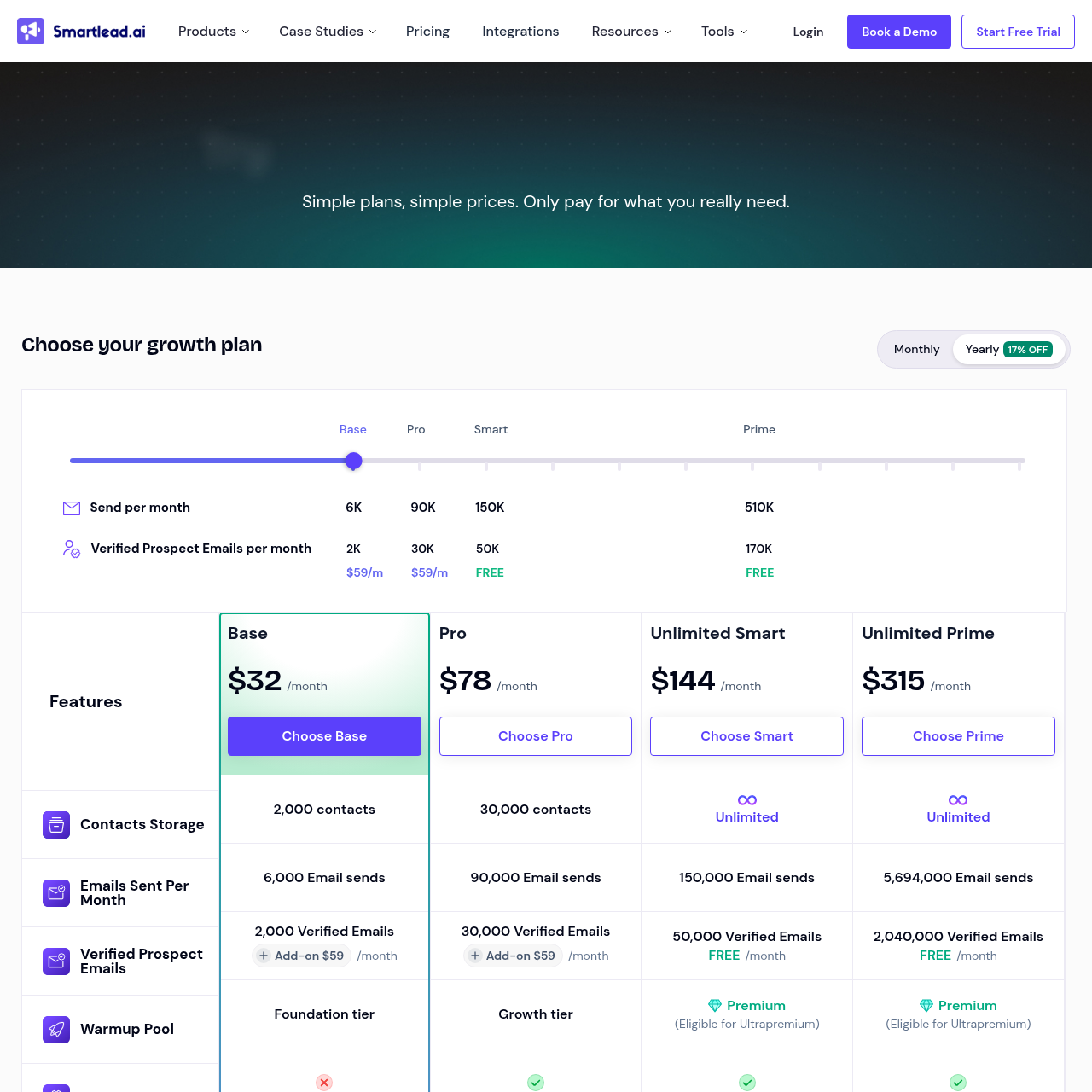
Smartlead plans, side by side
Basic
$39/mo
What you get
- Mailboxes subject to FUP (100 on Basic per smartlead.ai/fair-use-policy)
- Lead storage (subject to FUP)
- Email warmup
- Multi-channel outreach
- Basic analytics
Watch out for
- Shared infrastructure
- No dedicated servers
- Limited automation features
- Mailbox count capped at 100 per Fair Usage Policy
Pro
$94/mo
What you get
- Everything in Basic
- Advanced analytics
- Webhooks and integrations
- Priority support
- Custom tracking domain
Watch out for
- Still shared infrastructure
- Dedicated servers require SmartInfra add-on
- Dialer requires SmartDialer add-on
- Mailbox count capped at 300 per Fair Usage Policy
Custom
$174/mo
What you get
- Everything in Pro
- Custom sending limits
- Dedicated account manager
- Advanced API access
- Custom onboarding
Watch out for
- Still shared infrastructure by default
- SmartInfra, SmartDialer, SmartDelivery all extra
- Mailbox count capped at 800 per Fair Usage Policy
Cost estimator
The lowest list price is at $39/mo. Check the plan limits before you pick on price alone.
Estimate built only from the list prices above. Excludes add-ons, taxes, overages and discounts, see “What’s not included” below.
On this page7
Cost at volume
What Smartlead costs across the stacks teams actually run
- 1
Just the sequencer (Basic, no add-ons)
$39/mo
The cheapest way to run Smartlead: sequencer, shared servers, and standard warmup, nothing else. Fine as long as you stay under the 100-mailbox FUP cap and don't need any of the specialty products.
- 2
Pro tier, no add-ons attached
$94/mo
Brings in advanced analytics, webhooks, and a custom tracking domain, and lifts the mailbox cap to 300. Dedicated servers, the dialer, prospecting, and placement testing all still sit outside this tier.
- 3
Pro plus SmartInfra (the common mid-market setup)
$94/mo + $50-$200/mo
Where most teams end up once dedicated server allocation becomes necessary. SmartInfra tacks on roughly another $50 to $200/mo depending on fleet size.
- 4
Pro, SmartInfra, SmartProspect, and SmartDialer together
$200-$400/mo typical
A fuller build combining the sequencer, dedicated servers, prospecting, and calling. SmartDelivery and SmartAgents would be extra on top if you need those too.
- 5
Custom tier running the full suite
$300-$600/mo typical
The Custom base at $174 plus the four Smart-suite add-ons most customers adopt, with a dedicated account manager thrown in and an 800-mailbox cap.
How Sendbox compares
Sendbox plans start at $99/mo with dedicated IPs and the full deliverability suite included on every tier, no add-ons required.
The seven Smart-products orbiting the core sequencer
Smartlead's entire pricing structure comes down to its product portfolio. The sequencer is one purchase. Circling it are seven branded sub-products, each with its own checkout: SmartInfra (dedicated server allocation, quote-based pricing) SmartDialer (cold calling, separate subscription) SmartProspect (lead database, separate subscription) SmartDelivery (inbox placement testing, separate subscription) SmartSenders (managed mailbox infrastructure, quote-based) SmartAgents (AI workflows, separate subscription) Ultra Premium Warmup (advanced warmup engine, separate subscription) Nobody needs all seven.
A solo founder running a narrow outbound motion can stay entirely inside the Basic plan. A mid-market team typically ends up adding SmartInfra plus one or two others. Larger, enterprise-scale outbound teams often run five or six at once.
However many you stack is exactly how much the bill grows.
Key takeaways
- Seven branded Smart-products sit around the core sequencer
- Each one checks out separately, on its own billing line
- Mid-market teams typically adopt 2-4 of them
- The bill tracks stack depth, not just the sequencer tier
How Smartlead's Fair Usage Policy actually limits growth
Smartlead publishes more detail on its FUP than most competitors do, which is a genuine point in its favor, but the cap it describes is still a real constraint. Mailbox limits run 100 on Basic, 300 on Popular, and 800 on Pro, with Custom-tier allocations negotiated individually. That cap bites in two common scenarios.
The first is a mid-quarter volume spike: adding 50 mailboxes mid-month above your tier's cap requires manual approval, which isn't automatic and which the policy explicitly reserves the right to deny. The second is agency scaling: agencies juggling multiple clients hit the ceiling fast, since each client typically needs 5 to 20 mailboxes of their own. A five-client agency sitting on Pro's 300-mailbox cap is averaging 60 per client, workable, but with little room to spare.
The practical takeaway: size your plan against roughly 70 percent of your tier's cap rather than the full number, so you've got headroom for a surge without having to go negotiate an exception.
Key takeaways
- Mailbox caps run 100/300/800 across Basic/Pro/Custom
- Custom-tier allocations get negotiated separately
- Expanding mid-quarter requires manual, non-guaranteed approval
- Budget against roughly 70 percent of your cap for breathing room
The annual-billing math once you're running several Smart-products
Smartlead offers annual prepay discounts on its base sequencer tiers, and each individual Smart-product carries its own annual cycle with its own discount rate. That creates a real budgeting headache: a team running Pro plus SmartInfra, SmartDialer, and SmartProspect is now juggling four separate renewal dates, each on a different discount schedule. Working out the bundle-level savings isn't trivial either.
A team paying around $250/mo across four products might save $30 to $50/mo total by moving everything to annual, but only if every renewal date lines up. Switching mid-year gets messy because the unused portion of an existing monthly subscription doesn't always credit cleanly toward the new annual term. The pattern most teams settle into: pay monthly for the first 90 days while figuring out what your actual stack looks like, then shift whichever Smart-products you've confirmed you need onto annual billing.
That 90-day evaluation window typically costs 15 to 20 percent more than jumping straight to annual would have.
Key takeaways
- Annual discounts apply per Smart-product, each on its own cycle
- Working out bundle-level savings takes real math
- Switching mid-year doesn't credit cleanly against existing terms
- Most teams pay monthly for 90 days before locking in annual
Keep reading
You get the sequencer itself, multi-step campaigns, A/B testing, conditional logic, plus shared (not dedicated) servers, standard warmup, and basic analytics, with mailbox count capped at 100 under the Fair Usage Policy. SmartProspect, SmartDialer, SmartDelivery, and the rest of the Smart-suite aren't part of it; every one of them is a separate purchase.
Ready to land in primary?
Get your own isolated Sendbox setup running and start sending inside 15 minutes.
Every plan includes a dedicated IP. Cancel whenever you want.