

Apollo.io
Cold email platform · pricing breakdown
Apollo Pricing 2026: Per-Seat Credits and the 3-User Minimum
Apollo charges along three axes at once, seats, credits, and add-on dialers, and it's the interplay between them, not any single line, where the real bill takes shape.

- Plans
- 4
- Starts at
- Free plan
- Extra costs flagged
- 5
- Updated
- May 2026
Bottom line
It's unusual for this category, but Apollo bills on three fronts simultaneously. First, per seat: $49 for Basic, $79 for Professional, $119 for Organization, each charged per user per month. Second, per credit: the data lookups your team pulls from the 275M-plus contact database.
Third, per add-on dialer: parallel dialing, international dialing, and the power dialer each cost extra. These three axes don't operate in isolation, they compound together. Organization also carries a 3-user minimum, which puts its lowest possible bill at $357/mo no matter how few seats you actually need.
This structure rewards SDR-heavy organizations that put the database to real use, since credits get consumed productively and seat costs spread across several parallel callers, while it overcharges teams that mostly just want to send sequences and treat the database as an occasional tool. Credit where it's due on the free tier, 900 credits a year and 2 sequences makes it the most generous option in the category for evaluating the data layer on its own, even though it caps out fast once you try to run real sending workflows on it.
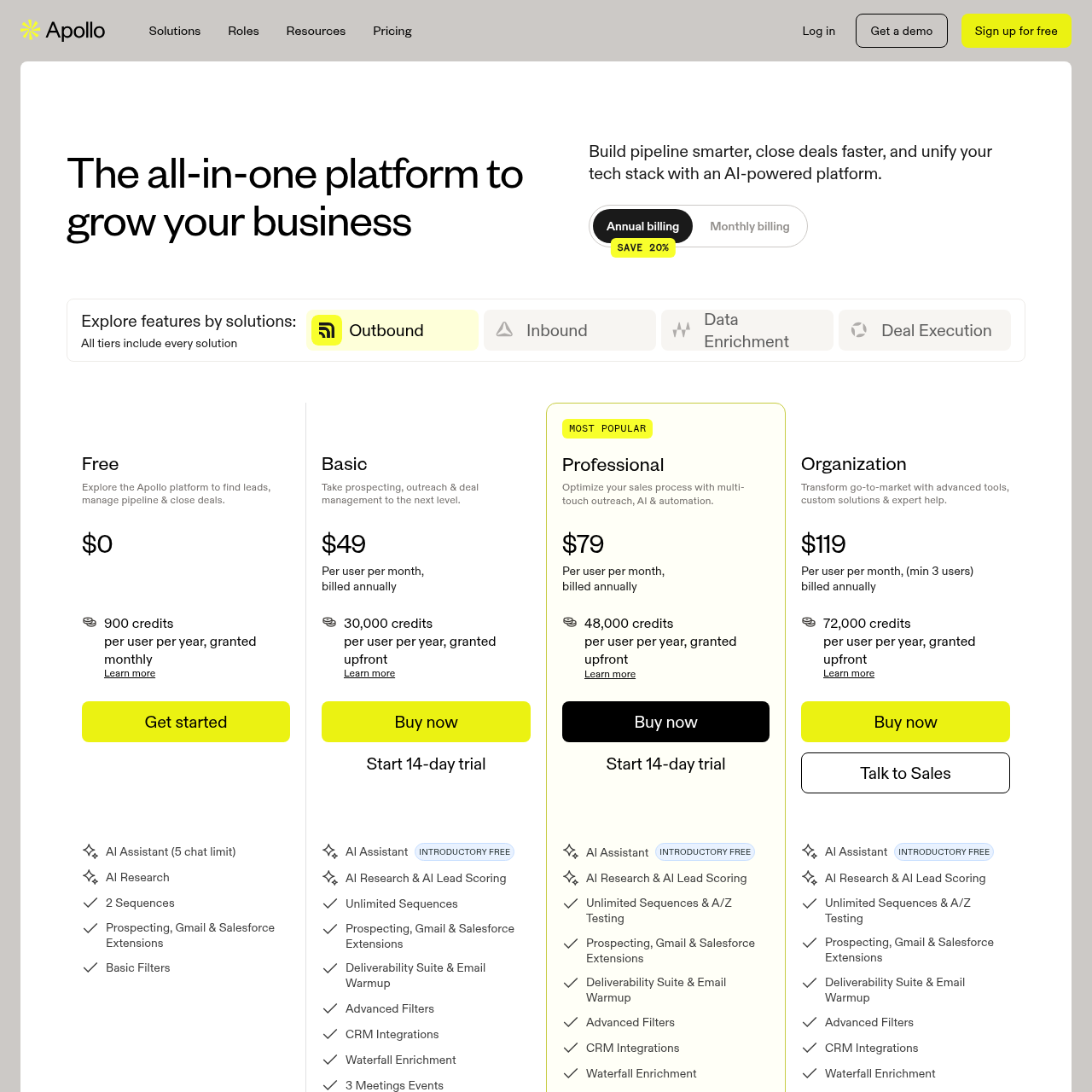
Plan breakdown
Apollo.io plans, side by side
Free
$0/mo
What you get
- 900 credits/year
- 2 active sequences
- Basic filters
- LinkedIn extension
- Limited API access
Watch out for
- Only 900 credits per year (75/mo)
- Only 2 sequences
- Very limited sending volume
- No warmup or deliverability tools
Basic
$49/user/mo
What you get
- 30,000 credits/year
- Unlimited sequences
- CRM integration
- Deliverability suite
- Warmup included
- A/B testing
Watch out for
- Per-user pricing
- 30K credits/year (2,500/mo)
- Shared infrastructure
- No parallel dialer
Professional
$79/user/mo
What you get
- 48,000 credits/year
- A/Z testing
- Advanced workflows
- US dialer included
- Task manager
- Conversation intelligence
Watch out for
- Per-user pricing
- 48K credits/year (4,000/mo)
- Still shared infrastructure
- International dialer is extra
Organization
$119/user/mo
What you get
- 72,000 credits/year
- SSO/SAML
- Advanced security
- Custom reports
- International dialer access
- Call transcription
Watch out for
- Minimum 3 users ($357/mo minimum)
- 72K credits/year (6,000/mo)
- Still shared infrastructure
- Parallel dialer is extra
Cost estimator
At 3 seats, the lowest list price is at $0/mo. Check the plan limits before you pick on price alone.
Estimate built only from the list prices above. Excludes add-ons, taxes, overages and discounts, see “What’s not included” below.
On this page8
Cost at volume
What Apollo costs across common team sizes and credit needs
- 1
Free tier, just for evaluation
$0/mo
Works out to about 75 credits a month effectively. Fine for kicking the tires on the data layer, but the 2-sequence cap rules out running any real campaign.
- 2
A solo SDR on Basic
$49/mo (annual)
One seat, 2,500 credits monthly, sequences uncapped. This is the sweet spot for an individual operator doing data-heavy outbound alone.
- 3
A solo SDR on Professional
$79/mo (annual)
Brings in A/Z testing, the US dialer, and 4,000 monthly credits. Worth paying for once calling becomes a real part of your workflow.
- 4
A 5-seat Basic team
$245/mo (5 x $49)
Five seats sharing 12,500 credits monthly. This works well for SDR teams that have agreed on how to split a shared credit pool.
- 5
A 5-seat Professional team
$395/mo (5 x $79)
Five seats, each with US dialer access. This is the configuration most SDR teams actually end up running.
- 6
Hitting Organization's minimum
$357/mo (3 seats x $119)
The 3-user floor on Organization means even a 2-person team that just wants SSO ends up paying for a third seat, effectively $119 for a seat nobody uses.
- 7
Professional plus the Parallel Dialer add-on
$79/seat + add-on
Parallel Dialer isn't priced publicly, it's quote-based, with reports putting it somewhere around $50-$100/user/mo for the add-on alone.
How Sendbox compares
Sendbox plans start at $99/mo with dedicated IPs and the full deliverability suite included on every tier, no add-ons required.
How seats, credits, and add-on dialers interact with each other
Apollo prices three variables at once, and their interaction is what produces the less-obvious bill outcomes: Seats. Every paid user added to the workspace brings its own seat fee ($49, $79, or $119 depending on tier), which buys access to the sequencer and database plus that seat's credit allocation. Credits.
Each seat comes with an annual credit allowance, 30K on Basic, 48K on Professional, 72K on Organization, which works out to roughly 2,500, 4,000, and 6,000 a month respectively. Heavy prospecting eats through this faster than the annual number suggests. Add-on dialers.
Parallel Dialer, International Dialer, and Power Dialer all price separately from the seat fee, though the US dialer itself comes bundled free starting at Professional. Here's the trap: teams that upgrade from Basic to Professional specifically to "get the dialer included" sometimes discover it only covers US numbers, and end up adding the International Dialer anyway, quietly eating into whatever savings the upgrade was supposed to deliver.
Key takeaways
- Three variables drive the bill: seats, credits, add-on dialers
- The US dialer ships free starting at Professional
- International calling needs a separate add-on regardless of tier
- Heavy prospecting can burn a full year of credits in months
When Organization's 3-user minimum actually matters
Organization requires a minimum of 3 seats, which sets its lowest possible bill at $357/mo ($119 x 3) no matter how many people on your team actually need access. That trips up two kinds of buyers in particular. One is the 2-person founder team that wants SSO purely for security compliance, they end up paying for a seat nobody uses just to unlock Organization, adding roughly $119/mo of pure overhead for an early-stage team.
The other is agencies managing 4-6 client accounts who'd rather buy 4 Organization seats but find the math doesn't favor them compared to 5 Professional seats, at 4 seats, Organization runs $476/mo against Professional's $316/mo for the same headcount. The rule of thumb: Organization pays off when you'd have provisioned 3-plus seats anyway. Below that actual seat need, or above it with mixed requirements, Professional usually wins on per-seat economics.
Key takeaways
- Organization's floor sits at $357/mo regardless of actual need
- Two-person founder teams end up paying for an unused seat
- Agencies often find Professional cheaper up through 4-5 seats
- Organization only pays off at the exact seat count you need
How Apollo credits actually burn through a normal sales month
How fast a team burns through Apollo credits comes down to what they're actually doing day to day. Three patterns show up consistently: Prospecting-heavy: SDRs running daily list builds against the database burn 300-500 credits per person per day. At that pace, a 5-person team can chew through a full year of Basic-tier credits (150K combined) in just 60-90 days.
Sequencer-only: teams that mostly live in the sequence builder and rarely pull fresh contacts burn closer to 50-100 credits per person per day, their annual allocation lasts the full year comfortably. Mixed: most SDR teams land somewhere in between, at 150-250 credits per person per day, which a solo operator can absorb on Basic but which forces a team-scale upgrade to Professional or a supplemental credit purchase. The practical approach: track your actual usage for 30 days during the free tier before committing, then size your plan against that real burn rate rather than the advertised credit totals.
Key takeaways
- Prospecting-heavy teams burn 300-500 credits per seat daily
- Sequencer-only teams burn just 50-100 credits per seat daily
- Most teams fall in between, at 150-250 per seat daily
- Measure your real burn during evaluation, not from marketing copy
Why every paid Apollo tier forces annual billing
There's no monthly billing option on any paid Apollo tier, every paid plan bills annually, upfront. That's a real constraint worth factoring into how big a commitment you're making. What that means in practice: No month-to-month trial of paid tiers: there's no way to pay for a single month of Professional to test it before committing to a full year.
The Free tier is the only truly no-risk way to evaluate. Cutting seats mid-term gets you nothing back: there's no pro-rated refund for seats you remove during the year, so hire-and-fire churn genuinely costs money on Apollo. Upgrading mid-term usually prorates within the existing annual contract, but it's worth confirming the exact mechanics with sales rather than assuming.
This forced-annual structure favors teams with stable, known headcount for the year ahead. It's a worse fit for seasonal teams, fast-hiring teams, and agencies whose client books turn over often.
Key takeaways
- Every paid Apollo tier bills annually, upfront
- There's no monthly option on any paid plan
- Cutting seats mid-term earns no pro-rated refund
- The Free tier is the only genuinely no-risk way to evaluate
Keep reading
The Free tier costs nothing and includes 900 credits a year. Basic runs $49/seat/mo with 30K credits per seat annually. Professional is $79/seat/mo with 48K credits. Organization costs $119/seat/mo, requires at least 3 users, and includes 72K credits per seat. Every paid tier bills on an annual basis.
Ready to land in primary?
Get your own isolated Sendbox setup running and start sending inside 15 minutes.
Every plan includes a dedicated IP. Cancel whenever you want.