

EmailBison
Cold email platform · pricing breakdown
EmailBison Pricing 2026: One Plan, One Price, One Kind of Buyer
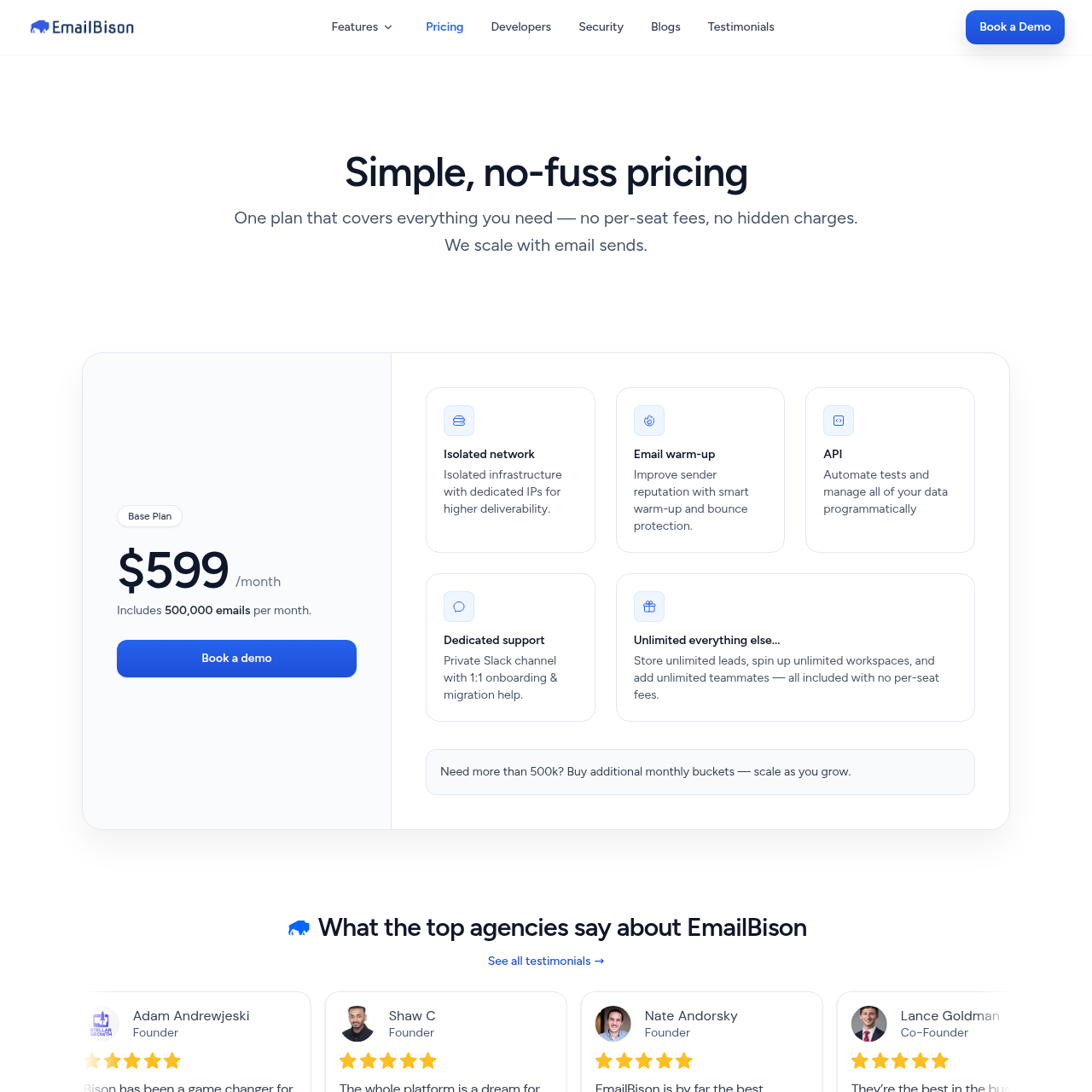
EmailBison sells exactly one plan, $599/mo for 500K sends, and that single-tier decision says a lot about who they're actually trying to sell to. Here's how the bucket-based economics behind that number actually work.

- Plans
- 2
- Starts at
- $599/mo
- Extra costs flagged
- 5
- Updated
- May 2026
Bottom line
EmailBison runs the most unconventional pricing strategy anywhere in cold email: exactly one published tier, one price, one fixed capacity. $599/mo buys 500,000 monthly emails backed by dedicated IPs, isolated VPCs, static egress, and private networking, no Starter, no Growth, no Pro, nothing to negotiate up through. That choice to publish a single plan tells you exactly what kind of buyer EmailBison is after.
The pricing page isn't there to walk you through whether 500K emails or dedicated IPs are worth it, it exists to confirm a number for buyers who already know they need this category of product. Casual shoppers bounce right off the $599 anchor; committed buyers find it lands right where they expected. Scale past 500K and the model stays strictly linear: every additional 500K costs another $599 flat, with no volume discount, no commitment discount, and no tier to graduate into.
Per-email cost holds steady at $0.0012 no matter how much you scale. The trade-off is real: anyone sending under 500K a month gets stuck with a structurally poor per-email rate, because there's no smaller tier built for lighter infrastructure needs. EmailBison either matches your scale or it simply doesn't fit.
Plan breakdown
EmailBison plans, side by side
Standard
$599/mo
What you get
- 500,000 emails/month
- Dedicated IPs
- Isolated VPCs
- Static egress
- Private networking
- Email warmup
- Master inbox
- Sequencing with A/B testing
- Conditional logic
- Unlimited leads
- Unlimited workspaces
- Unlimited teammates
- API and webhooks
- Clay, HubSpot, Salesforce integrations
- EmailGuard (inbox placement)
- Dedicated support
Watch out for
- No lead finder or prospecting database
- No dialer
- No ESP matching
- No SEG detection
- No blacklist monitoring
Additional Volume
$599 per additional 500K bucket
What you get
- Additional email volume beyond 500K
- Same infrastructure and features
- $599 per additional 500K email bucket
Watch out for
- Still no lead finder or dialer at any volume
Cost estimator
Estimate built only from the list prices above. Excludes add-ons, taxes, overages and discounts, see “What’s not included” below.
On this page7
Cost at volume
EmailBison bucket economics across different utilization levels
- 1
Using the full bucket (500K/mo)
$599/mo
Works out to $0.0012 per email, the utilization level this pricing is built around, and roughly on par with what a comparable self-built AWS SES setup would cost at this scale.
- 2
Using half the bucket (250K/mo)
$599/mo
Per-email cost doubles to $0.0024, since you're paying for full capacity while only using half of it. Not broken, just inefficient.
- 3
Light usage (100K/mo)
$599/mo
Per-email cost climbs to $0.006. Teams sending at this volume are usually better served by a tool actually sized for it rather than over-buying capacity here.
- 4
Two buckets (1M/mo)
$1,198/mo
Per-email cost holds steady at $0.0012, buying a second bucket brings no volume discount over the first.
- 5
Five buckets (2.5M/mo)
$2,995/mo
Scaling stays strictly linear all the way up. Buyers operating at this volume should ask directly about negotiated rates, since nothing like that appears in the public pricing model.
How Sendbox compares
Sendbox plans start at $99/mo with dedicated IPs and the full deliverability suite included on every tier, no add-ons required.
Why publishing a single plan is a deliberate choice, not laziness
Most SaaS companies publish four or five tiers to capture different types of buyers. EmailBison publishes exactly one, and that's a strategic call, not a shortcut. A single tier accomplishes three things at once.
It filters out unqualified buyers before they ever reach the pricing conversation, since only people who genuinely need this category of infrastructure bother engaging with a $599 anchor. It also sets a clean, binary value question, there's no Starter to compare against, so the decision becomes "is this worth $599" rather than "which tier should I pick." And it simplifies the sales process itself, since reps are negotiating volume buckets, not tiers. The cost of this approach: teams that actually need something like 200K sends a month at premium infrastructure quality get no option tailored to them.
They either overpay for capacity they won't use or look elsewhere. EmailBison seems entirely fine with that outcome, it's functioning exactly as intended, as a filter for the customers they want.
Key takeaways
- A single tier filters out unqualified buyers early
- It reframes the pricing question as binary, not tier-relative
- It simplifies sales conversations down to volume alone
- Buyers under the bucket size lose out by design, not oversight
What $599 buys versus building the same infrastructure yourself
That $599 covers infrastructure pieces that serious enterprise senders would otherwise have to assemble themselves on AWS SES or a similar platform: Dedicated IPs, typically $30-$80/mo per IP on AWS SES once you factor in reputation management overhead. An isolated VPC environment, roughly $50-$200/mo for a properly configured setup with security groups and routing. Static egress IPs, Elastic IPs run around $4/mo each, plus NAT gateway costs on top.
Private networking via something like AWS PrivateLink, priced around $0.01 per GB plus $7.20/mo per interface endpoint. And then there's the deliverability tooling layered on top of all that raw infrastructure, warmup, a master inbox, sequencing, AI tagging, and EmailGuard's placement testing. Add it all up and a self-built equivalent on AWS SES typically runs $1,500-$5,000/mo in pure infrastructure, plus 1-2 engineer-quarters to build it and ongoing maintenance afterward.
EmailBison packages that entire assembly into a managed $599/mo service. For buyers who need exactly this infrastructure profile and would rather not build it themselves, that math favors EmailBison clearly.
Key takeaways
- A self-built AWS SES equivalent runs $1,500-$5,000/mo in infrastructure alone
- Plus roughly 1-2 engineer-quarters just to build it
- Plus the ongoing burden of maintaining it
- EmailBison packages the equivalent as a $599 managed service
What else you need to run alongside EmailBison
EmailBison covers the infrastructure layer alone, a complete outbound operation needs a few more pieces bolted on. Common combinations include: Lead discovery through Apollo, Hunter, Clay, or Smartlead's SmartProspect, typically running $49-$200/mo depending on volume. A dialer like Aircall or JustCall, usually $25-$100/mo per user.
ESP-aware routing, which isn't really sold as a standalone product, it's usually baked into a sender tool's own routing logic, and EmailBison doesn't offer it natively. Blacklist monitoring through standalone tools like MXToolbox or HetrixTools, generally $50-$150/mo. A CRM, HubSpot, Salesforce, or Pipedrive, connected through EmailBison's integrations.
Put together, the full stack lands around EmailBison's $599 base plus another $200-$500 for supporting tools. Teams that prefer assembling best-of-breed tools will find this approach natural. Teams that want everything consolidated into one product will find EmailBison's narrow scope a structural mismatch with what they're looking for.
Key takeaways
- A typical stack pairs EmailBison with lead discovery, a dialer, monitoring, and a CRM
- That adds roughly $200-$500/mo on top of the EmailBison base
- Enterprise buyers tend to favor this best-of-breed approach
- Buyers wanting one consolidated tool find EmailBison's scope too narrow
Keep reading
Sources
The single published plan runs $599/mo, covering 500,000 emails a month along with dedicated IPs, isolated VPCs, static egress, and the full feature set. Any additional volume comes in 500K buckets, each priced the same $599.
Ready to land in primary?
Get your own isolated Sendbox setup running and start sending inside 15 minutes.
Every plan includes a dedicated IP. Cancel whenever you want.