 vs
vs
Lemlist vs Apollo (2026): Per-Seat Creative Depth vs Per-Seat Data Depth
Both platforms bill per seat, but they pour that fee into opposite ends of the workflow. Lemlist invests in the multichannel sequencer; Apollo invests in its 275M-contact database and intent signals.


The verdict
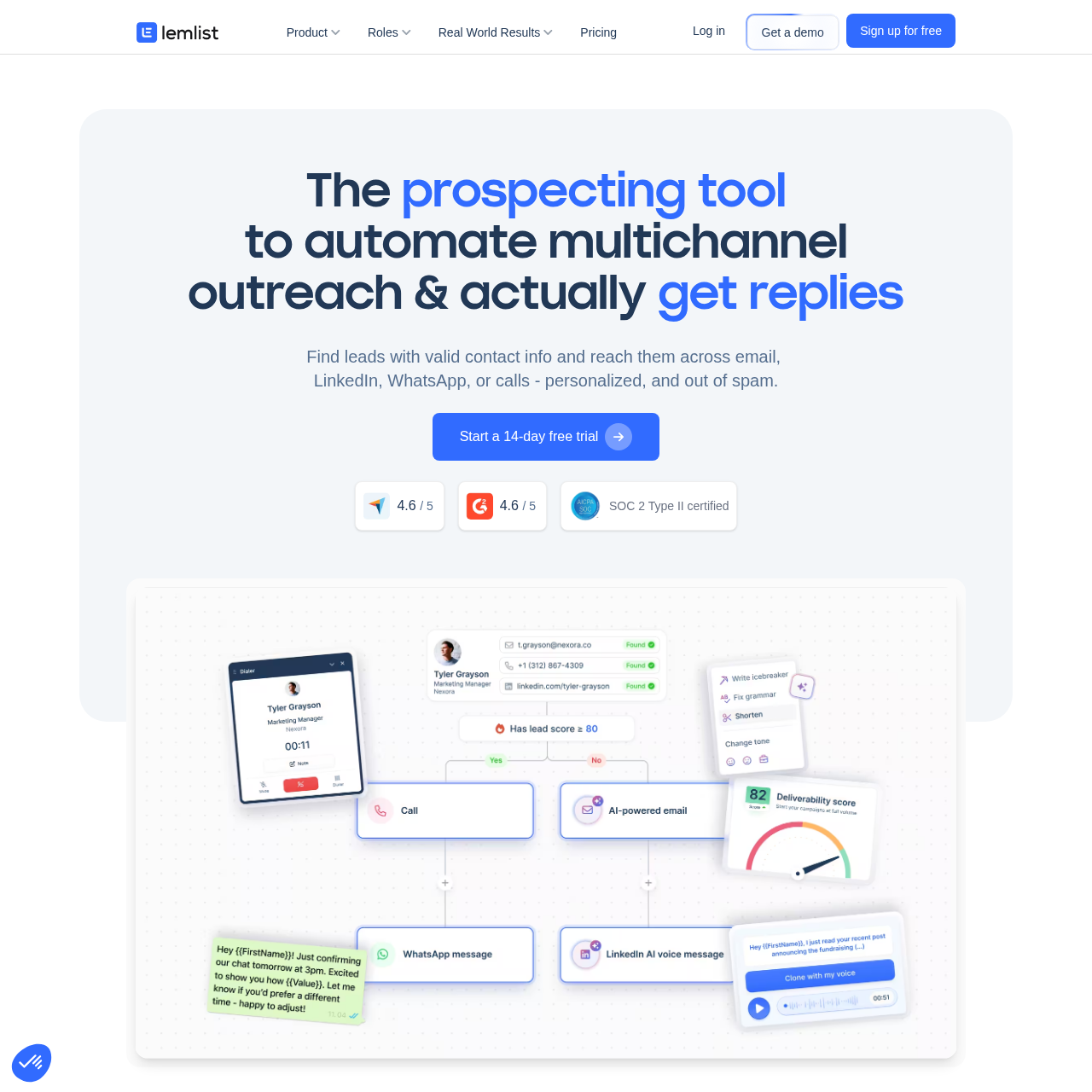
Lemlist and Apollo both bill by the seat, but each channels that fee toward a different end of the outbound process. Lemlist (Email Pro at $79/seat, Multichannel Expert at $109/seat) pours engineering effort into LinkedIn integration, the multichannel sequence builder, and AI-driven image and landing-page personalization, creative output is what sets it apart. Apollo (Basic at $49/seat, Professional at $79/seat, Organization at $119/seat with a 3-user minimum) pours its effort into the 275M-contact database, intent signals, and a credit-metered data layer, data depth is what sets it apart.
A solo operator pays somewhere between $49 and $79 on either platform for comparable solo-outbound capability. Mid-market teams tend to choose based on where their funnel actually needs the investment: Lemlist when the message itself is the bottleneck, Apollo when finding the right person is. Plenty of teams run both together, with Apollo feeding data upstream and Lemlist handling the sending downstream.

Where it leads
Lemlist
- Full multichannel automation across email, LinkedIn, WhatsApp, and calling
- A 600M+ lead database with enrichment
- AI personalization extends to images, thumbnails, and landing pages

Where it leads
Apollo.io
- A 275M+ database paired with buyer intent data and alerts
- A built-in CRM with pipeline and deal tracking
- A free plan offering 900 credits to start
 SendboxThe third option
Where Lemlist sells creative depth per seat and Apollo sells data depth per seat, Sendbox sells reputation isolation per workspace. Its entry plan gives a 5-person team the same flat bill as a solo operator, with dedicated IPs and a generous send allowance regardless of headcount, something neither Lemlist nor Apollo offers at any seat count.
Feature by feature
Lemlist vs Apollo.io: Feature-by-Feature
Toggle Sendbox in or out, filter by category, or keep only the rows where the tools differ.
| Feature | Lemlist | Apollo.io | Sendbox |
|---|---|---|---|
| Infrastructure | |||
| Dedicated IPs | Lemlist No No plan offers a dedicated IP option | Apollo.io No No plan offers a dedicated IP option | Sendbox Every plan Dedicated IPs are included across every plan tier |
| Isolated Infrastructure | Lemlist No IPs rotate through a shared pool on every plan | Apollo.io No Infrastructure is shared across every plan | Sendbox Yes Sending stays fully isolated on every plan |
| Email Warmup | Lemlist lemwarm included The built-in warmup tool ships on every plan | Apollo.io Basic Warmup exists but isn't a primary focus | Sendbox Unlimited, AI-powered AI-driven warmup built to slip past detection filters |
| Email Validation | Lemlist Built-in Verification is already part of the platform | Apollo.io Built-in Verification runs through the credit system | Sendbox Built-in, every plan Runs deliverability checks across 10+ provider integrations, with Enrich.so built in or your own API key |
| Pricing | |||
| Pricing Model | Lemlist Per-user Runs $79-$109 per seat monthly | Apollo.io Per-user + credits Runs $49-$79+ per seat monthly, plus a credit system | Sendbox Flat rate One flat monthly fee, nothing charged per seat |
| Starting Price | Lemlist $79/user/mo Email Pro allows 3 sending accounts per seat | Apollo.io Free / $49/user/mo A free plan (900 credits) or Basic at $49 per seat | Sendbox Flat monthly fee Essential tier: 75K emails, 30K leads, dedicated IPs |
| Sending | |||
| Email Accounts | Lemlist 3-5 per user 3 on Email Pro, 5 on Multichannel Expert | Apollo.io Limited Tied to how many mailboxes each user connects | Sendbox Unlimited Unlimited in practice, the fair-use ceiling is generous enough that typical users never hit it |
| Features | |||
| Lead Database | Lemlist 600M+ contacts Built in, with enrichment layered on | Apollo.io 275M+ contacts The core of the platform, with intent data attached | Sendbox Built-in finder A lead finder ships inside the platform |
| CRM | Lemlist No No native CRM is offered | Apollo.io Built-in A full CRM with pipeline and deal tracking ships in | Sendbox Built-in A pipeline CRM with deal tracking is included |
| Intent Data | Lemlist No No buyer intent data is offered | Apollo.io Yes Buyer intent signals and alerts are included | Sendbox No Not currently offered |
| AI Personalization | Lemlist Advanced AI personalizes text, images, thumbnails, and landing pages | Apollo.io AI writing AI helps write and suggest email copy | Sendbox AI reply tagging Sorts replies into categories automatically |
| Channels | |||
| LinkedIn Automation | Lemlist Yes Profile visits, invites, and messages run natively (Multichannel Expert) | Apollo.io Task-based LinkedIn steps surface in sequences as manual tasks | Sendbox No Built around email and phone, not LinkedIn |
| WhatsApp Outreach | Lemlist $20/user/mo add-on Sold as an add-on on Multichannel Expert | Apollo.io No No WhatsApp integration exists | Sendbox No Not currently offered |
| Built-in Dialer | Lemlist Yes Calling ships inside Multichannel Expert | Apollo.io Yes A dialer ships on Professional and above | Sendbox Yes Native calling on every plan |
| Other | |||
| Free Plan / Trial | Lemlist 14-day trial A 14-day free trial is offered | Apollo.io Free plan A free plan offers 900 credits monthly | Sendbox No A demo is available by booking a call |
| Scale | |||
| White-label | Lemlist Enterprise only Requires the custom Enterprise plan | Apollo.io No No white-label option is offered | Sendbox Available on Pro tier Full white-label ships on the Pro plan |

Showing 16 of 16 features.
Where the Per-Seat Math Diverges
Both platforms bill by the seat, but that fee buys entirely different things. Lemlist Email Pro ($79/seat) and Multichannel Expert ($109/seat) give each operator the LinkedIn automation engine, a WhatsApp connector slot ($20/user add-on), and an AI personalization studio covering images and landing pages, every additional seat extends the full multichannel surface to that user. Apollo Basic ($49/seat), Professional ($79/seat), and Organization ($119/seat with a 3-user minimum) instead give each operator access to the 275M-contact database, the credit-metered data layer, plus the integrated sequencer and CRM, every additional seat adds another data-consuming workspace.
Where the crossover lands depends entirely on what the seat is doing. A solo founder focused on creative outbound gets more value from Lemlist's $109, with its richer per-message tooling. A solo founder buried in data-heavy prospecting gets more from Apollo Basic's $49, since Lemlist simply can't match that database depth.
At three seats, Apollo Organization's 3-user floor (a $357 minimum) starts to bite, while Lemlist Multichannel Expert runs $327 for the same three seats with no such floor. The two seat fees cross paths at different points depending on which feature set you actually need.
Key takeaways
- Lemlist's seat fee buys creative depth, LinkedIn, a WhatsApp slot, AI personalization
- Apollo's seat fee buys data depth, the 275M database, intent signals, and credits
- Apollo Organization enforces a 3-user minimum; Lemlist scales one seat at a time
- Solo creative outbound favors Lemlist; solo data-heavy work favors Apollo
Lemlist Add-Ons vs Apollo Credits
Both vendors meter consumption beyond the seat fee, just around entirely different resources. Lemlist meters channels: WhatsApp costs $20 per user monthly on top of Multichannel Expert, dialer calling adds a per-number fee ($15/user) plus per-minute rates, extra sending mailboxes beyond the included 3-5 cost $9 each per user, and Claap AI video personalization runs $60 per user. The Lemlist bill climbs with however many channels and creative tools you switch on.
Apollo meters data lookups through its credit system instead. Basic includes 30,000 credits monthly, Professional 48,000, Organization 120,000. An email reveal costs roughly 1 credit, phone numbers cost 8-10, and bulk enrichment runs higher still.
The Apollo bill climbs once credits run out and you either upgrade the seat tier or purchase additional packs, heavy prospectors can burn through 30K credits in 8-10 days on Basic. The practical difference: Lemlist grows expensive as you turn on more channels per operator, while Apollo grows expensive as you prospect more aggressively against the database. Operators layering 3-4 Lemlist add-ons per seat end up spending an effective $130-$170 per seat.
Operators burning through Apollo credits weekly get pushed into Professional or Organization regardless of whether they actually need the extra seat capability.
Key takeaways
- Lemlist's add-ons: WhatsApp $20, dialer numbers $15, extra mailboxes $9, Claap $60, all per user
- Apollo meters data lookups via credits, ranging 30K-120K depending on seat tier
- An Apollo email reveal costs roughly 1 credit; a phone number costs 8-10
- Lemlist gets expensive per channel activated; Apollo gets expensive per prospect pulled
Want dedicated IPs on every plan?
Sendbox bundles isolated infrastructure, warmup and a dialer. From $99/mo.
LinkedIn: Lemlist Automated vs Apollo Task-Based
This is where these two seat-priced platforms diverge most sharply. Lemlist Multichannel Expert automates the entire LinkedIn motion: profile visits trigger on a schedule, connection requests fire from a sequence step, accepted connections route straight into a messaging campaign, and the whole chain runs without any operator clicking through. It works via a Chrome extension paired with cloud automation, and it's the most mature LinkedIn automation anywhere in the cold email category.
Apollo includes LinkedIn steps in sequences too, but treats them as manual tasks. When a sequence reaches a LinkedIn step, it lands in your task queue with a deep link to the prospect's profile, you click through, send the request or message by hand, and mark it complete, with the sequence paused until you act. That's a deliberate design choice: Apollo treats LinkedIn as a high-touch surface that deserves operator judgment rather than automation throughput.
The trade-off is concrete. Lemlist scales LinkedIn without consuming operator time, but carries the platform-policy risk that aggressive automation can trigger Sales Navigator account restrictions. Apollo never runs that risk, but caps LinkedIn output at whatever an operator can physically click through in a day.
Teams running 200+ LinkedIn touches per operator weekly need Lemlist; teams running 30-50 carefully-crafted touches do fine on Apollo's task-based model.
Key takeaways
- Lemlist automates the full LinkedIn motion, visits, invites, and messages, hands-free
- Apollo surfaces LinkedIn steps as manual tasks inside a queue
- Lemlist carries account-restriction risk at high automation volumes
- Apollo caps LinkedIn output at whatever the operator can click through
Migrating Between Lemlist and Apollo
Teams move between Lemlist and Apollo for opposite reasons. Apollo-to-Lemlist migrations tend to happen once a team realizes it needs real LinkedIn automation and creative personalization that Apollo's manual task steps simply can't deliver. The painful part is rebuilding lists, Apollo's intent-prioritized prospect lists don't transfer over to Lemlist's enrichment, so the cohort has to be re-sourced from scratch.
The upside is that sequence step logic carries over cleanly, since both platforms support similar conditional branching. Lemlist-to-Apollo migrations tend to happen when a team decides the prospecting layer matters more than the multichannel surface. Apollo's buyer intent signals and tech-stack filters expose targeting depth Lemlist's enrichment simply doesn't reach.
What gets lost in the move: Lemlist's creative assets, personalized image campaigns, dynamic landing pages, have no Apollo equivalent and effectively vanish from the sequence design. Expect a 6-8 week ramp to recover sequence performance after shifting from creative-led to data-led outreach. One constant across both directions: neither platform exports sending reputation.
Whatever warmup history built up on Lemlist or Apollo stays locked inside that platform, and the destination mailbox starts its warmup relationship from zero.
Key takeaways
- Apollo-to-Lemlist migrations mean rebuilding lists from scratch, with no intent-priority carryover
- Lemlist-to-Apollo migrations lose creative assets entirely; expect a 6-8 week recovery ramp
- Sequence step logic translates cleanly in either direction
- Neither platform exports sending reputation when you switch
Strengths & limitations
Pros & Cons
Strengths5
- Full multichannel automation across email, LinkedIn, WhatsApp, and calling
- A 600M+ lead database with enrichment
- AI personalization extends to images, thumbnails, and landing pages
- A 14-day free trial
- Stronger email deliverability tooling, including lemwarm and verification
Limitations5
- No dedicated IPs on any plan
- Per-seat pricing runs $79-$109 per user monthly
- Capped at 3-5 sending accounts per user
- No native CRM or buyer intent data
- WhatsApp adds another $20 per user monthly
Strengths5
- A 275M+ database paired with buyer intent data and alerts
- A built-in CRM with pipeline and deal tracking
- A free plan offering 900 credits to start
- A dialer included from Professional onward
- An all-in-one blend of sales intelligence and engagement
Limitations5
- No dedicated IPs on any plan
- Per-seat pricing grows costly for teams
- LinkedIn steps stay manual rather than automated
- The credit system can constrain heavy prospecting
- Email warmup is fairly basic next to dedicated tools
Strengths5
- Dedicated IPs included on every plan
- Flat-rate pricing with nothing charged per seat
- Every deliverability tool included on every plan
- A native dialer and CRM
- The most cost-effective option once a team passes 3 people
Limitations4
- No LinkedIn automation or WhatsApp
- No buyer intent data or sales intelligence
- Fewer integrations than Apollo's ecosystem, being newer
- A smaller user community, being newer
On the sticker, Apollo Professional is $30 cheaper per seat. The honest read for a solo user: Lemlist hands you automated LinkedIn, a WhatsApp slot ($20 extra), and AI image personalization that Apollo's seat simply doesn't include. Apollo Professional hands you a dialer, the 275M database, and intent signals Lemlist can't match. That $30 monthly gap essentially covers whichever resource the other platform under-invests in, so this is rarely a pure price question, it's about which capability gap actually costs you more.
Ready to land in primary?
Get your own isolated Sendbox setup running and start sending inside 15 minutes.
Every plan includes a dedicated IP. Cancel whenever you want.