 vs
vs
Lemlist vs EmailBison in 2026: Per-Seat Multichannel Reach Against Workspace-Level Infrastructure
Lemlist puts its seat fees toward multichannel creative capability, while EmailBison puts one workspace fee toward premium email infrastructure. The two products barely chase the same priorities.

The verdict
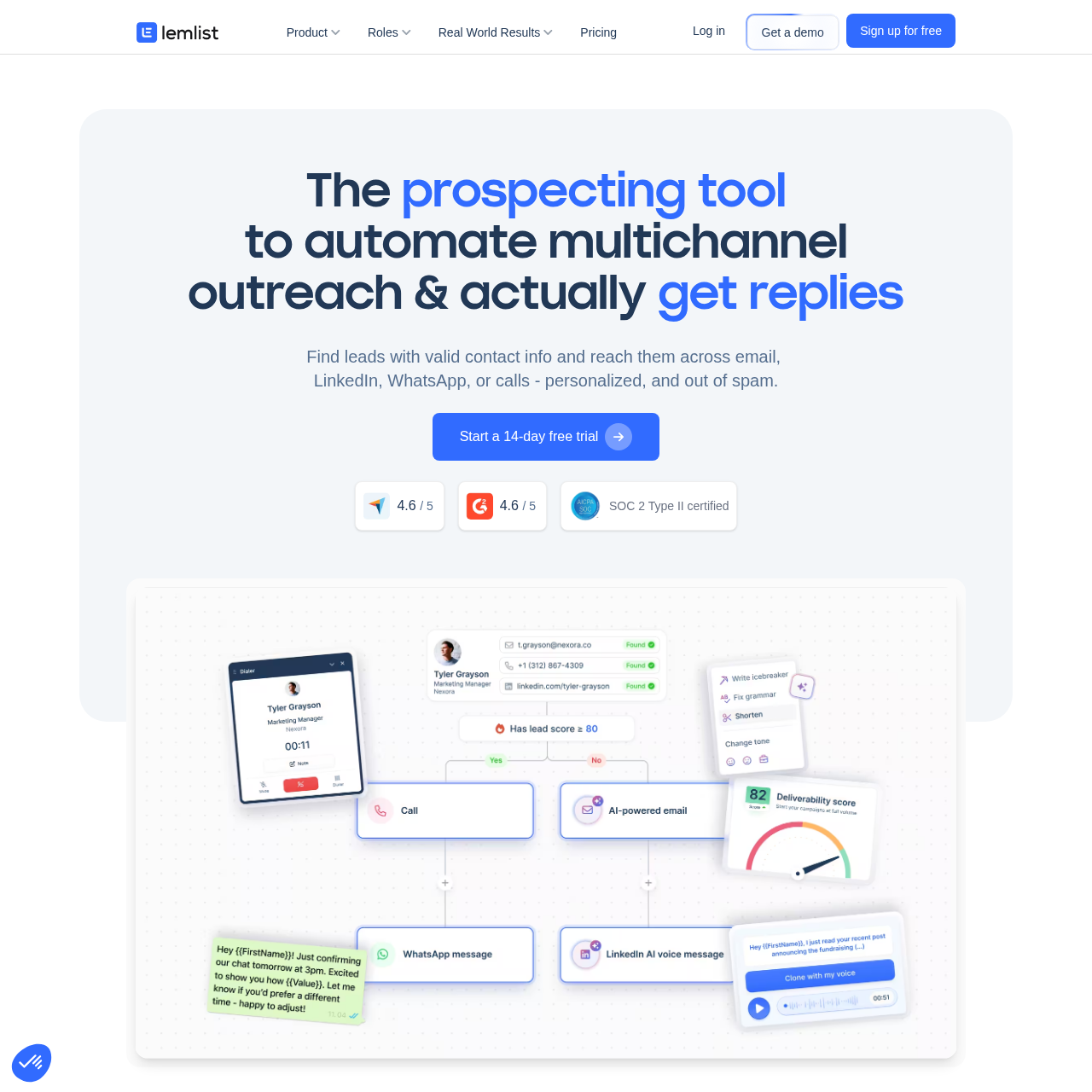
Lemlist and EmailBison hardly compete for the same buyer at all. Lemlist (Email Pro at $79/seat, Multichannel Expert at $109/seat) pours its seat revenue into sequencer creativity, LinkedIn integration, WhatsApp messaging, AI personalization across images and landing pages, and multichannel sequence orchestration. It treats email infrastructure as a commodity and treats creative depth as the thing worth paying for.
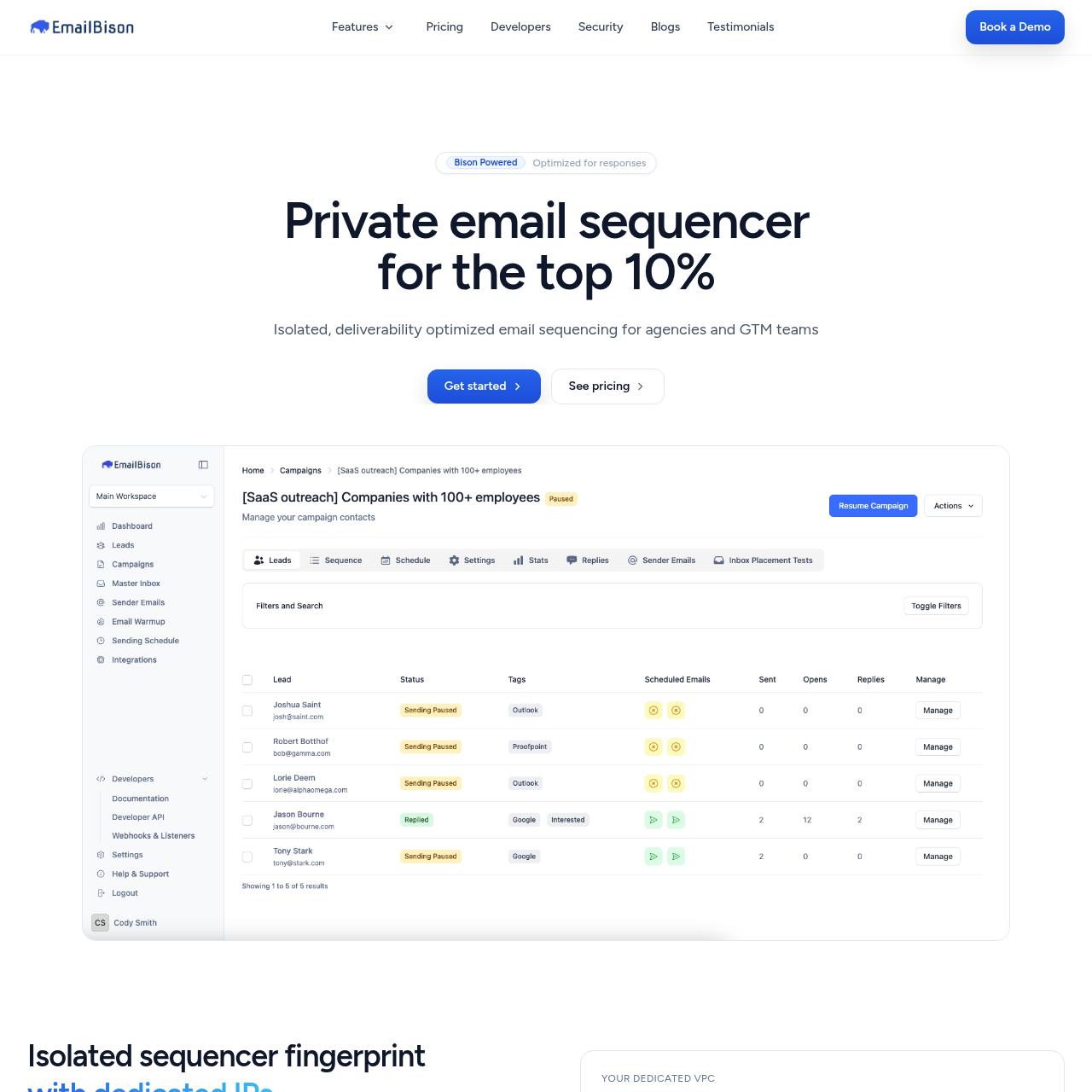
EmailBison, priced at a single $599/mo plan, flips that entirely: email infrastructure, dedicated IPs, isolated VPCs, static egress, is the differentiator, while the sequencer itself stays functional but secondary. Someone choosing Lemlist is prioritizing what the email actually says; someone choosing EmailBison is prioritizing whether the email actually arrives. The pricing structure mirrors that priority, Lemlist charges per seat because creative output scales with the number of people producing it, while EmailBison charges per workspace because infrastructure capacity scales with volume, not headcount.
A fair number of teams that evaluate both end up running them side by side to cover both ends of the workflow at once.

Where it leads
Lemlist
- Covers email, LinkedIn, WhatsApp, and calling in one platform
- Database of 450M+ contacts built in
- AI-powered reply categorization

Where it leads
EmailBison
- Dedicated IPs and isolated VPCs included from the start
- Static egress paired with private networking
- EmailGuard covers inbox placement testing
 SendboxThe third option
Along the creative-depth-versus-infrastructure-depth spectrum that separates Lemlist and EmailBison, Sendbox leans toward the EmailBison side, priced per workspace with dedicated IPs included, but at a far lower entry point than EmailBison's commitment.
On this page· 1/9
- The Verdict
- Where Sendbox Fits
- Feature Comparison
- Seat compounding on Lemlist vs the EmailBison bucket
- Creative sequence depth (Lemlist) vs sending-engine quality (EmailBison)
- LinkedIn automation: a Lemlist advantage with no EmailBison equivalent
- Why some teams actually run Lemlist and EmailBison simultaneously
- Pros & Cons
- FAQ
Feature by feature
Lemlist vs EmailBison: Feature-by-Feature
Toggle Sendbox in or out, filter by category, or keep only the rows where the tools differ.
| Feature | Lemlist | EmailBison | Sendbox |
|---|---|---|---|
| Infrastructure | |||
| Dedicated IPs | Lemlist No Not offered on any plan | EmailBison Yes Bundled into the $599/mo plan | Sendbox Every plan Dedicated IPs come standard on every tier |
| Isolated Infrastructure | Lemlist No Runs on shared, rotating IPs | EmailBison Yes Runs on isolated VPCs with static egress | Sendbox Yes Sending is fully isolated on every tier |
| Email Warmup | Lemlist lemwarm Warmup tool built directly into the platform | EmailBison Yes Warmup ships as part of the product | Sendbox Unlimited, AI-powered AI-driven warmup built to slip past detection filters |
| Pricing | |||
| Pricing Model | Lemlist Per-user Roughly $79-$109+ per seat monthly | EmailBison Flat rate One plan, priced flat at $599/mo | Sendbox Flat rate One flat monthly rate per workspace |
| Starting Price | Lemlist $79/user/mo Email Pro: 3 sending mailboxes per seat | EmailBison $599/mo The single plan: 500K emails plus dedicated IPs | Sendbox Flat tier pricing Essential tier: 75K emails, 30K leads, dedicated IPs included |
| Channels | |||
| LinkedIn Automation | Lemlist Yes Covers profile visits, invites, and messages on Multichannel Expert | EmailBison No No LinkedIn automation offered | Sendbox No Focused on email and phone only |
| Built-in Dialer | Lemlist Yes Calling included on the Multichannel Expert plan | EmailBison No No dialer built in | Sendbox Yes Cold calling built natively into every tier |
| Features | |||
| Lead Database | Lemlist 450M+ contacts Built-in finder covering both email and phone | EmailBison No No lead finder offered | Sendbox 350M+ contacts Lead finder ships built in on every plan |
| AI Reply Tagging | Lemlist AI categorization Reply detection handled by AI | EmailBison Yes AI reply tagging is available | Sendbox Yes AI-powered reply categorization and tagging |
| CRM Integrations | Lemlist Native + Zapier Native connections to HubSpot, Salesforce, and Pipedrive | EmailBison Clay, HubSpot, Salesforce Connects via API and webhooks | Sendbox Built-in CRM + integrations Native CRM alongside HubSpot and Salesforce connections |
| Scale | |||
| White-label | Lemlist No No white-label option offered | EmailBison Yes White-label branding is available | Sendbox Pro tier Complete white-labeling unlocked on the Pro tier |

Showing 11 of 11 features.
Seat compounding on Lemlist vs the EmailBison bucket
Lemlist's real pricing doesn't behave the way the sticker suggests. Email Pro lists at $79/seat and Multichannel Expert at $109/seat, but the seat price is only the starting point. Teams actually using the platform tend to stack add-ons on top, extra sending mailboxes per user, the WhatsApp module at $20/user, the lemcal scheduler, lead finder credits, and the agency layer for managing sub-accounts.
Fully provision a four-person sales team on Multichannel Expert with those add-ons included, and the bill climbs into the high $500s, right around the point where EmailBison's flat $599 starts looking competitive purely on price. EmailBison runs the opposite model: one published tier, $599 for 500K monthly sends. Need more volume? You buy another 500K bucket for another flat $599, with no volume discount built in, the pricing stays deliberately rigid.
That predictability is a plus for finance teams tracking one workspace fee instead of headcount, but it's a penalty for anyone whose volume sits well below 500K, since the floor and the ceiling are the same number at that tier. The underlying pattern: Lemlist's cost grows unpredictably alongside team size and feature adoption, while EmailBison's cost grows predictably but only in fixed 500K increments. Which one fits better depends entirely on how your team operates.
Key takeaways
- Lemlist starts at a $79-$109 base seat, then compounds with five-plus add-ons
- EmailBison publishes one tier: a flat $599 for 500K sends
- Lemlist's bill tracks headcount and how many add-ons a team adopts
- EmailBison's bill jumps in flat 500K increments, with no volume discount
Creative sequence depth (Lemlist) vs sending-engine quality (EmailBison)
Lemlist channels its product investment into the creative side of cold email, liquid-syntax personalization, image personalization down to the variable level, dynamic landing pages, video personalization, lemcal scheduling, and what's arguably the strongest native LinkedIn automation in the category (profile visits, invite-with-note, scheduled messages, voice notes). The sequencer is where the product differentiates itself; email infrastructure is treated as "good enough" running on shared IPs. EmailBison puts its investment in the opposite place entirely: the sending engine.
Isolated VPCs, static egress, private networking, EmailGuard for placement testing, and dedicated IPs shared with no one else. Its sequencer features, A/B testing, conditional steps, a master inbox, AI reply tagging, are solid but clearly secondary to the deliverability story it's telling. Choosing Lemlist over EmailBison is effectively saying creative depth matters more than infrastructure depth for your use case; choosing EmailBison says the reverse.
Teams running ABM against 200 named accounts, where every touch needs heavy personalization, tend to lean Lemlist. Teams pushing 100K-plus emails monthly, where every percentage point of inbox placement translates directly into revenue, tend to lean EmailBison.
Key takeaways
- Lemlist invests in image, video, landing-page, and LinkedIn personalization
- EmailBison invests in VPCs, static egress, dedicated IPs, and EmailGuard
- The two platforms are making opposite R&D bets within the same category
- The right choice depends on which side of the workflow actually drives revenue
Want dedicated IPs on every plan?
Sendbox bundles isolated infrastructure, warmup and a dialer. From $99/mo.
LinkedIn automation: a Lemlist advantage with no EmailBison equivalent
Lemlist's LinkedIn module isn't just present, it's one of the strongest implementations in the cold-email category. Connection requests with personalized notes, sequential message threads, profile visits timed to mimic human behavior, voice-note delivery, and the ability to weave LinkedIn steps directly into email sequences with conditional branching. This is the feature that justifies paying $109/seat for Multichannel Expert if your team treats LinkedIn as a genuine co-channel rather than a bolt-on.
EmailBison has none of that, no LinkedIn automation, no WhatsApp module, no native calling. It's built as an email-only product by design. Running a multichannel sequence on EmailBison means pairing it with a separate LinkedIn tool (HeyReach, Expandi, La Growth Machine) and reconciling reporting across two platforms, workable, but never as clean as having both channels live in one sequencer.
This gap is really the biggest reason the two products aren't interchangeable. A team committed to LinkedIn-plus-email outreach can't swap in EmailBison without losing sequencing depth. A team committed to high-volume email-only outreach can't swap in Lemlist without losing infrastructure quality.
Key takeaways
- Lemlist's native LinkedIn covers invites, messages, profile visits, and voice notes
- EmailBison offers no LinkedIn, no WhatsApp, and no dialer
- Multichannel-focused buyers can't substitute EmailBison for Lemlist
- High-volume email-only buyers can't substitute Lemlist for EmailBison
Why some teams actually run Lemlist and EmailBison simultaneously
One of the more telling patterns in this comparison: a meaningful share of teams that evaluate both tools end up running them in parallel instead of choosing one. The split tends to follow the workflow itself. Lemlist handles the high-touch ABM book, where each contact gets hand-tuned sequences and LinkedIn integration genuinely matters.
EmailBison handles the high-volume top-of-funnel motion, where 50K-200K sends a month need to land in the inbox rather than the spam folder. The combined bill isn't cheap, Lemlist's seat costs stacked on top of EmailBison's workspace fee, but the operational logic holds up: the two products don't overlap enough to make consolidation worthwhile, and using each where it's strongest justifies paying for both. Teams that land on this setup usually have a clean split between an inside-sales motion (running through Lemlist) and a growth-marketing motion (running through EmailBison), each tracked against its own KPIs.
Key takeaways
- Running both tools at once is a documented pattern, not a workaround
- Lemlist covers high-touch ABM where LinkedIn integration matters
- EmailBison covers high-volume top-of-funnel email
- The two workflows rarely overlap enough to justify consolidating
Strengths & limitations
Pros & Cons
Strengths5
- Covers email, LinkedIn, WhatsApp, and calling in one platform
- Database of 450M+ contacts built in
- AI-powered reply categorization
- Cheaper entry point for solo users at $79/mo
- Strong personalization capabilities
Limitations5
- Per-seat pricing adds up fast for teams
- No dedicated IPs on any plan
- Runs on shared, rotating IP infrastructure
- LinkedIn actions are capped per sender
- WhatsApp only comes as a paid add-on ($20/user/mo)
Strengths5
- Dedicated IPs and isolated VPCs included from the start
- Static egress paired with private networking
- EmailGuard covers inbox placement testing
- No per-seat charges, unlimited teammates included
- Dedicated hands-on support
Limitations5
- Just one plan at $599/mo, with nothing cheaper available
- Email-only, with no multichannel outreach
- No lead finder or prospecting database
- No ESP matching or SEG detection
- No dialer or CRM
Strengths5
- Dedicated IPs included on every plan
- 350M+ contact lead finder plus a native dialer
- One flat rate rather than per-seat charges
- AI reply tagging and CRM included
- White-labeling available on the Pro tier
Limitations3
- No LinkedIn or WhatsApp automation
- Starts at a higher price point than Lemlist for solo users
- No mobile app yet
It depends on the plan and how many add-ons get adopted. A five-person team on Multichannel Expert ($109/seat) runs roughly $545 before add-ons; once WhatsApp ($20/seat), extra sending mailboxes, and lemcal get layered on, that typically climbs into the $700-$900 range, comfortably past EmailBison's $599. Solo users and small teams tend to stay cheaper on Lemlist; mid-sized teams cross over once they've adopted enough add-ons.
Ready to land in primary?
Get your own isolated Sendbox setup running and start sending inside 15 minutes.
Every plan includes a dedicated IP. Cancel whenever you want.